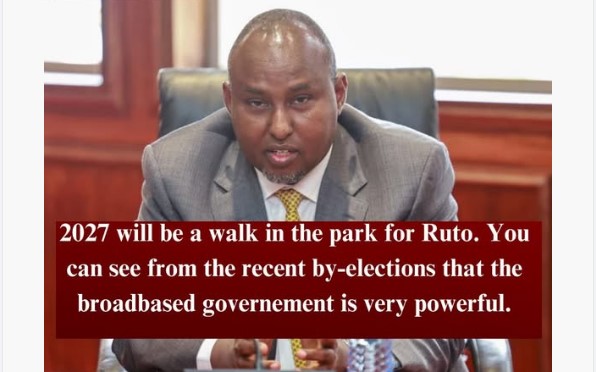
Suna East MP Junet Mohamed has sparked fresh political debate after declaring that President William Ruto will have an easy time securing re-election in 2027. According to Junet, recent by-election results have clearly demonstrated the strength and influence of the broad-based government formed under the Kenya Kwanza administration.
Junet argued that the coalition-building strategy adopted by Ruto has significantly expanded his political base across the country, making it difficult for any opposition formation to mount a serious challenge. “2027 will be a walk in the park for Ruto,” Junet said. “You can see from the recent by-elections that the broadbased government is very powerful.”
He noted that the victories Kenya Kwanza has secured in various by-elections are not coincidental but a reflection of a well-organized political machine that has managed to bring together influential leaders from different regions. Junet added that the current administration’s ability to attract formerly opposition-aligned politicians shows that Ruto’s grip on national politics is strengthening by the day.
According to him, unless the opposition restructures itself, unites, and presents a compelling alternative agenda, President Ruto is already on a fast track to retaining power. He emphasized that the opposition is currently weakened, disjointed, and unable to counter Kenya Kwanza’s growing influence on the ground.
Junet’s comments quickly triggered reactions across the political landscape. Supporters of the president praised the remarks, saying they reflect the reality on the ground, where government-backed candidates have been winning seats with little resistance. Kenya Kwanza allies celebrated the endorsement, calling it proof that even seasoned opposition voices acknowledge the government’s dominance.
However, critics dismissed Junet’s statement as political exaggeration. Some argued that by-elections cannot be used as the sole indicator of national political mood, citing that government candidates traditionally enjoy state machinery and resources. Others insisted that the political environment will change significantly before 2027, and the opposition still has time to regroup and challenge Ruto.
Despite the contrasting views, Junet’s remarks add to the growing conversation about the shifting political dynamics in Kenya. As 2027 approaches, analysts predict that alliances, defections, and political negotiations will continue to shape the landscape—making the race far from settled, despite claims of an easy victory for the president.