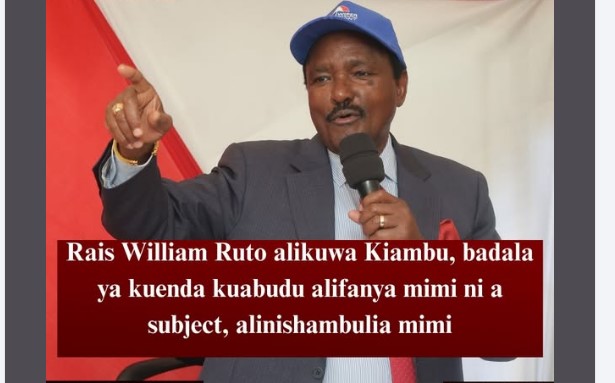
Wiper Party leader Kalonzo Musyoka has accused President William Ruto of using a church event in Kiambu to launch a political attack against him, raising fresh questions about the growing overlap between politics and places of worship. According to Kalonzo, the President chose to single him out for criticism instead of focusing on the purpose of the gathering, which was meant for worship.
Kalonzo expressed disappointment, arguing that a church setting should promote unity, reflection, and moral guidance rather than political confrontation. He claimed that being turned into a “subject” of attack in such a space was inappropriate and reflected poorly on leadership values. To him, the incident symbolized a worrying trend where sacred platforms are increasingly used to score political points.
At the heart of his complaint is the belief that leaders should separate governance and partisan politics from religious gatherings. Kalonzo suggested that churches should not become arenas for personal or political battles, especially at a time when the country is grappling with economic hardship and social tension. In his view, such moments should be used to offer hope and reassurance to citizens rather than deepen divisions.
The incident also highlights the intensifying rivalry between President Ruto and opposition figures. As political temperatures rise, public appearances—whether in rallies, funerals, or churches—have become strategic spaces for messaging. What was once considered neutral ground is now frequently drawn into political contests, blurring the line between faith and politics.
Supporters of Kalonzo argue that his criticism is justified, noting that religious institutions command moral authority and wide public trust. They believe politicizing church events risks alienating worshippers and undermining the spiritual role these institutions play in society. From this perspective, leaders should exercise restraint and respect the sanctity of such spaces.
However, others contend that public figures cannot completely separate politics from public appearances, especially when addressing large gatherings. They argue that leaders naturally respond to criticism wherever platforms are available, and that churches, like other social spaces, reflect the realities of national discourse.
Ultimately, Kalonzo’s remarks reignite an ongoing national conversation about leadership conduct and the role of religion in politics. As Kenya moves forward, the challenge remains balancing freedom of expression with respect for institutions meant to unite rather than divide. Whether such incidents help or harm leaders politically will depend on how citizens interpret the use of sacred spaces in an increasingly polarized political environment.