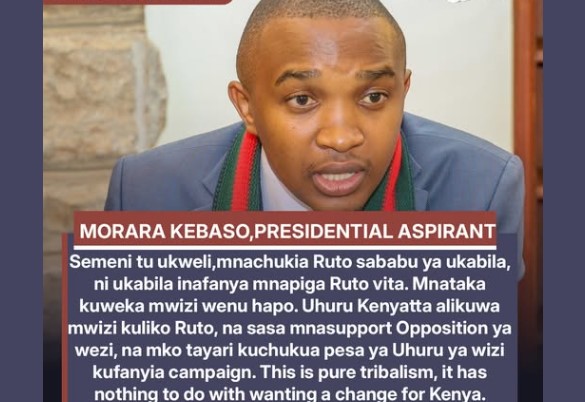
Political analyst Morara Kebaso has sparked intense debate after defending President William Ruto, accusing critics of tribalism rather than genuine concern for Kenya’s future. Speaking recently, Kebaso argued that much of the opposition against Ruto is fueled by ethnic biases rather than policy disagreements.
He stated, “Semeni tu ukweli, mnachukia Ruto sababu ya ukabila. Ni ukabila inafanya mnapiga Ruto vita. Mnataka kuweka mwizi wenu hapo. Uhuru Kenyatta alikuwa mwizi kuliko Ruto, na sasa mnasupport opposition ya wezi, na mko tayari kuchukua pesa ya Uhuru ya wizi kufanyia campaign. This is pure tribalism, it has nothing to do with wanting a change for Kenya.”
Kebaso’s comments have reignited discussions about ethnicity in Kenyan politics, highlighting the deep divisions that often shape voter behavior. Supporters of Ruto have echoed his statements, claiming that political attacks against the president are often unfairly colored by tribal sentiments rather than objective evaluation of his performance.
On the other hand, critics argue that leadership accountability and governance concerns cannot be dismissed as tribalism, emphasizing the need for substantive debate over Kenya’s development path.
As the political climate heats up ahead of upcoming elections, Kebaso’s remarks underline the continuing role of ethnicity in political discourse and the challenges of addressing national issues without bias.