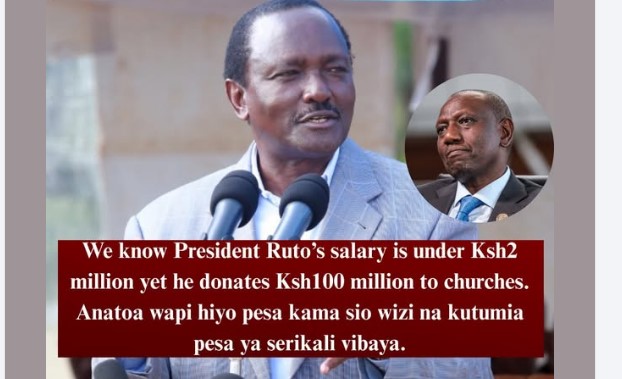
Wiper Party leader and former Vice President Kalonzo Musyoka has raised eyebrows after questioning the source of President William Ruto’s substantial donations to religious institutions. Speaking during a political rally, Musyoka expressed disbelief that a sitting president earning a reported Ksh2 million monthly salary could contribute Ksh100 million to churches, suggesting possible misuse of public funds.
“We know President Ruto’s salary is under Ksh2 million, yet he donates Ksh100 million to churches. Anatoa wapi hiyo pesa kama sio wizi na kutumia pesa ya serikali vibaya,” Musyoka stated, implying that the donations could be linked to state resources rather than personal wealth.
The former vice president went on to argue that such lavish contributions raise serious questions about transparency and accountability in the handling of public funds. He urged Kenyans to demand clarity and accountability from leaders who engage in high-profile philanthropic acts, especially when those acts involve amounts far exceeding personal earnings.
Musyoka’s remarks have ignited political debate online, with critics of the government supporting his call for scrutiny, while supporters of Ruto dismissed the claims as politically motivated attacks. Analysts say such statements are part of the broader contest ahead of the 2027 elections, with opposition leaders increasingly targeting the president’s credibility.
Religious leaders who received the donations have remained largely silent, though some have praised Ruto’s generosity as a reflection of his personal commitment to supporting faith-based initiatives. However, questions about the source of the funds continue to dominate public discourse.
The controversy underscores ongoing concerns about public trust, leadership ethics, and the separation between personal charity and state resources in Kenya.