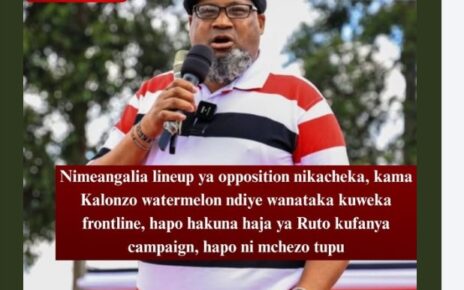
Wiper Party leader Kalonzo Musyoka has once again made headlines with a bold statement directed at members of the Orange Democratic Movement (ODM). Speaking during a political function, Kalonzo declared, “Ile heshima mnaweza kumpatia Raila Odinga nyinyi kama wana ODM ni kuhakikisha hakuna mtu atadhubutu kusema he will look after ODM. Niliskia Ruto akisema hiyo nikashangaa kabisa. Kama kuna mtu ODM inafaa kushikana naye ni mimi!”
Translated, the statement means: “The best way to honor Raila Odinga, as ODM members, is to ensure that no one dares to say he will look after ODM. I heard Ruto say that and I was completely surprised. If there’s anyone ODM should unite with, it should be me.”
Kalonzo’s remarks come at a time when Kenya’s political landscape is undergoing major realignment following the absence of Raila Odinga from the local scene due to his international duties. His words were seen as both a defense of Raila’s legacy and a strategic declaration of his own relevance in Kenya’s opposition politics.
For decades, ODM has been synonymous with Raila Odinga, a leader whose influence has shaped Kenya’s political history. However, with Raila’s transition to a continental role, questions about who should carry on his political vision have become common. President William Ruto’s recent comments suggesting that his administration would “look after ODM” were viewed by many as an attempt to neutralize opposition and expand his political reach.
Kalonzo, however, was quick to reject such overtures, arguing that ODM is not an orphan in need of care from the government. His statement was a reminder that the opposition has capable leaders who can sustain Raila’s legacy and continue the struggle for justice, equality, and good governance. By saying, “Kama kuna mtu ODM inafaa kushikana naye ni mimi,” Kalonzo was not only defending ODM’s independence but also positioning himself as Raila’s natural successor.
This statement also revealed the growing strategic closeness between the Wiper and ODM parties within the Azimio coalition. Kalonzo’s call for unity is likely to resonate among Raila’s supporters who view him as a loyal ally who stood by Baba through thick and thin — from the 2013, 2017, and 2022 elections. His consistency in defending Raila’s political ideals sets him apart from leaders who quickly shift allegiance for political convenience.
However, critics argue that Kalonzo’s remarks could be interpreted as political self-promotion rather than pure loyalty. Some believe he is using Raila’s absence to assert himself as the new opposition leader, a move that could create friction within the Azimio camp if not handled carefully. Nevertheless, his message carries emotional weight for ODM supporters who are still adjusting to the post-Raila political reality.
In conclusion, Kalonzo Musyoka’s statement reflects both loyalty and ambition. It reinforces his long-standing partnership with Raila Odinga while subtly announcing his readiness to take up the mantle of leadership within the opposition. Whether ODM will embrace him as their next torchbearer remains to be seen, but one thing is clear — Kalonzo wants to ensure that Raila’s legacy is protected by those who truly walked with him, not those seeking to benefit from his absence.