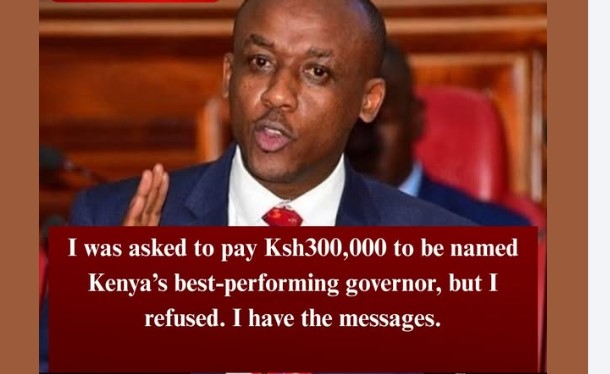
Makueni Governor Mutula Kilonzo Jr. has raised serious allegations against a pollster, claiming he was asked to pay Ksh 300,000 to influence his ranking in a performance survey. According to Mutula, he declined the request and retained messages that he says prove the solicitation. He further alleged that after refusing to pay, the pollster ranked another Ukambani governor as the second-best-performing governor in Kenya, raising questions about the credibility of such surveys.
The governor’s claims have ignited debate on the integrity of opinion polls and performance rankings, which are increasingly used to shape public perception of leaders. Poll results often influence political narratives, media coverage, and even voter confidence. If manipulated, they risk misleading the public and undermining democratic accountability.
Mutula’s allegation points to a broader concern about the commercialization of credibility. In an environment where rankings can be bought, performance surveys lose their value as tools for objective assessment and instead become instruments of political or financial leverage. This not only disadvantages leaders who refuse to participate in such schemes but also distorts the truth about service delivery and governance.
Supporters of the Makueni governor argue that his refusal to pay reflects integrity and consistency with his reformist image. They note that Makueni has often been cited for innovations in healthcare, public participation, and accountability, suggesting that genuine performance should speak louder than paid endorsements. From this perspective, Mutula’s claims reinforce calls for transparency in how polls are conducted and funded.
On the other hand, critics caution that allegations of this magnitude should be backed by full disclosure and independent investigation. They argue that pollsters also deserve the opportunity to respond, and that public trust can only be restored through verifiable evidence rather than political statements alone.
The controversy also raises questions about why political rankings carry so much weight. In a healthy democracy, citizens should rely more on lived experiences—such as service delivery, infrastructure, and governance—rather than league tables whose methodologies are often unclear. The incident serves as a reminder that not all surveys are created equal, and that scrutiny is essential.
Ultimately, Mutula Kilonzo Jr.’s claims have reopened an uncomfortable conversation about ethics in political polling. Whether or not the allegations are proven, they highlight the urgent need for regulation, transparency, and accountability in opinion research to ensure that public trust is not traded for money or influence.