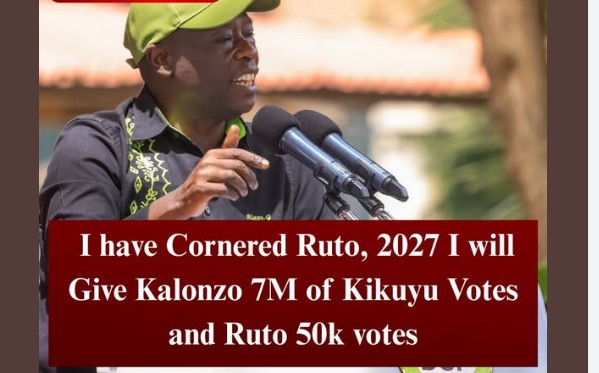
Deputy President Rigathi Gachagua has once again shaken the political landscape after claiming he has successfully cornered President William Ruto ahead of the 2027 elections. In a fiery declaration, Gachagua said he is now in full control of Mt. Kenya’s political direction and vowed to hand over 7 million Kikuyu votes to Wiper leader Kalonzo Musyoka—while promising to give President Ruto just 50,000 votes.
Gachagua’s remarks, which have instantly gone viral, mark one of his most dramatic political threats yet. The Deputy President appears to be positioning himself as the undisputed leader of the Mt. Kenya region, insisting that Ruto has lost significant support due to what he describes as betrayal, disrespect, and broken promises to the mountain community.
According to Gachagua, Mt. Kenya residents feel abandoned by the Kenya Kwanza government, despite being the backbone of Ruto’s 2022 victory. By declaring that he alone controls millions of Kikuyu votes, Gachagua is sending a strong warning that the political tide has shifted and that he is ready to redirect the region’s support to a new ally—Kalonzo Musyoka—whom he has recently praised as a “more trustworthy partner.”
Gachagua’s claim that he would deliver only 50,000 votes to Ruto is a symbolic demonstration of his dissatisfaction with the President. It signals a deep fracture within the ruling coalition and further confirms the rising tensions between the two top leaders. His statements also reflect an escalating battle for political survival, influence, and control over the voting bloc that often determines presidential outcomes.
Reactions to Gachagua’s remarks have been sharply divided. His supporters applaud his boldness, arguing that Mt. Kenya has indeed been sidelined in government appointments, economic opportunities, and development priorities. They believe Gachagua is speaking the truth and defending the region’s dignity.
Critics, however, accuse him of engaging in political blackmail and emotional manipulation. They argue that votes are not personal property that leaders can distribute at will. Others point out that Gachagua’s open hostility toward his boss could destabilize the government, weaken Kenya Kwanza, and worsen political divisions just two years before the elections.
Regardless of where one stands, Gachagua’s declaration is a major moment in Kenya’s evolving political narrative. It signals that the Mt. Kenya vote—which has historically determined presidential winners—is once again up for grabs. It also raises new questions about alliances, betrayals, and the unpredictable path toward 2027.
One thing is certain: Gachagua’s bold claim has reignited the political fire, set off fresh debates, and positioned him at the center of Kenya’s most heated political conversation.