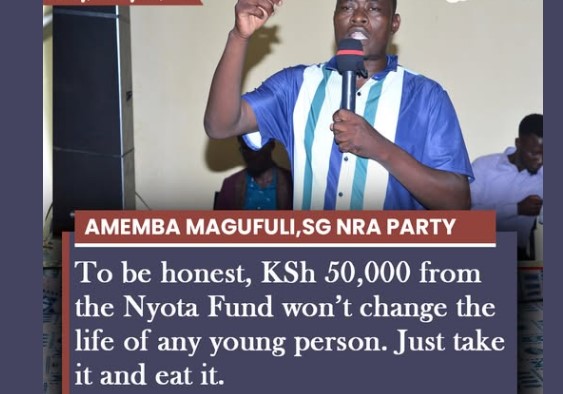
Political activist Amemba Magufuli has sparked debate after dismissing President William Ruto’s cash handouts, arguing that small monetary allocations cannot meaningfully change the lives of ordinary Kenyans. Speaking during a public exchange that has since circulated online, Magufuli bluntly stated that “KSh 50,000 cannot transform anyone’s life,” urging leaders to rethink their approach to economic empowerment.
Magufuli criticized what he described as a culture of political tokenism, where short-term cash giveaways are presented as solutions to deep-rooted economic challenges. According to him, such amounts may offer temporary relief but fail to address long-term issues such as unemployment, high living costs, and lack of sustainable income opportunities. His remarks resonated with sections of the public who believe that structural reforms matter more than symbolic gestures.
In his comments, Magufuli went further to accuse political leaders of using handouts as a political tool rather than a genuine development strategy. He suggested that resources would be better directed toward job creation, small business financing, and policies that empower citizens to become economically independent instead of relying on occasional payouts.
The statement has drawn mixed reactions. Supporters argue that Magufuli is voicing what many Kenyans privately feel—that meaningful change requires systems, not handouts. Critics, however, say his language was unnecessarily confrontational and dismissive of programs intended to provide short-term support to vulnerable groups.
The exchange once again highlights a recurring debate in Kenyan politics: whether direct cash support is an effective development tool or merely a political strategy. As economic pressure continues to weigh heavily on households, calls for sustainable solutions are growing louder, with citizens increasingly demanding policies that go beyond short-term financial relief.