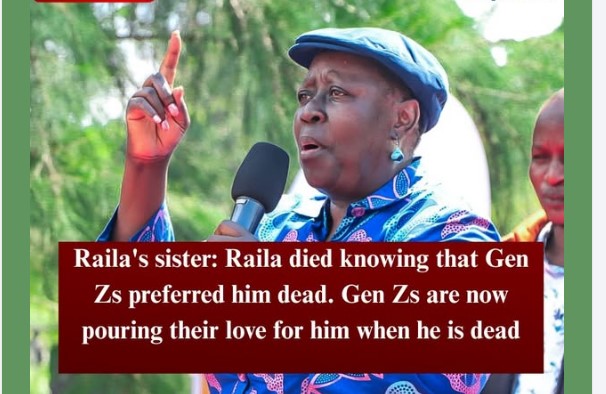
As Kenyans continue to mourn the passing of former Prime Minister Raila Amolo Odinga, emotions remain high across the country. While millions have expressed sorrow and admiration for the late opposition leader, his sister, Ruth Odinga, has delivered a sharp rebuke to a section of the youth — particularly members of Generation Z — accusing them of hypocrisy in their reaction to Raila’s death.
Speaking emotionally, Ruth Odinga said that while Gen Zs are now loudly praising and mourning Raila, many of them had previously shown open hostility toward him when he was still alive. She claimed that Raila died knowing that some young Kenyans wished him dead, only for the same group to now flood social media with glowing tributes.
“You are the same people, especially you as Gen Z, who are telling me about the outpouring of love now that he is gone,” she said. “But when he was alive, you were saying ‘akufe’ — that he should die. He died knowing that you preferred him dead.”
Ruth, who serves as the Kisumu County Woman Representative, expressed deep disappointment at what she described as insincere mourning. She reminded Kenyans that her brother dedicated his entire life to fighting for democracy, justice, and the rights of ordinary citizens — including the youth — and deserved to be appreciated while he was still alive.
“For those who said those things when he was still alive, it was really wrong,” she added. “And for those who have shown their love right now, you didn’t know the reality would be this. The loss is not just for our family, but for Kenya.”
Her remarks have stirred debate nationwide, with many agreeing that Raila’s legacy was often underappreciated, while others argue that the younger generation’s frustrations with long-serving political figures were justified. In recent years, Gen Zs have become increasingly vocal against what they see as entrenched political dynasties and corruption in government.
During the 2024 Gen Z–led protests against the Finance Bill, many young Kenyans criticized both the ruling government and opposition figures for failing to bring meaningful change. Some of that anger, Ruth believes, unfairly turned toward her brother, who despite his age, remained an active political figure trying to mediate between the government and the people.
Now, following his death, the same generation has filled social media with tributes, creative art, poems, and messages of sorrow celebrating Raila as a freedom icon and father of democracy. To Ruth, however, much of that praise feels like “too little, too late.”
Raila Odinga, who died in October 2025 at the age of 80, spent over four decades in Kenyan politics. He was detained multiple times for standing up against dictatorship, served as Prime Minister from 2008 to 2013, and vied for the presidency five times. His death marked the end of an era and left a deep void in Kenya’s political landscape.
Whether Ruth Odinga’s comments were made in pain or as a sincere reflection of her late brother’s feelings, they highlight a generational rift in how Kenyans perceive leadership, legacy, and loyalty. While older generations remember Raila as a hero who fought for democracy, many young people view him as part of an outdated political system they want to replace.
Still, in death, Raila Odinga seems to have achieved what he spent his life pursuing — unity. Across all ages, backgrounds, and political affiliations, Kenyans have come together to honor his life and service. And even amid the accusations and regrets, his legacy continues to inspire debate, reflection, and perhaps, a deeper understanding of what it truly means to love a leader while he is still alive.