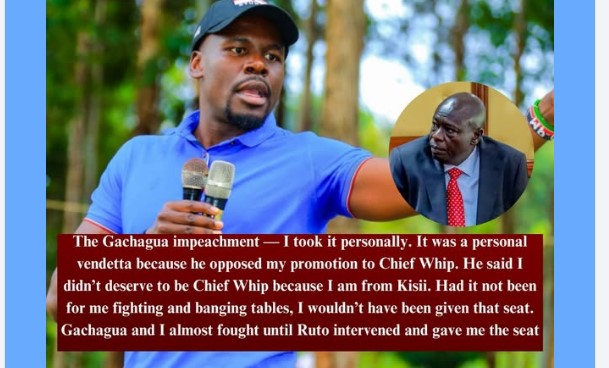
South Mugirango MP Silvanus Osoro has sparked a new political storm after openly admitting that his push to impeach Deputy President Rigathi Gachagua was driven by personal reasons. According to Osoro, Gachagua had despised him and allegedly rejected the idea of him becoming the National Assembly Majority Whip simply because he comes from Kisii. Osoro’s bold revelation has reignited debate about the true forces behind high-stakes political battles in Kenya.
Osoro claims that the conflict between him and Gachagua did not begin with the impeachment motion itself but with earlier tensions inside government ranks. He alleges that Gachagua viewed him as unsuitable for a key leadership position and dismissed the possibility of a Kisii MP holding the influential Chief Whip role. This, Osoro says, wounded him personally and motivated his decision to lead the charge against the Deputy President.
The MP’s unusually candid confession has raised eyebrows across the political scene. For many Kenyans, it exposes the extent to which personal grudges and internal power rivalries can shape national politics. In a country where political decisions are often framed as being in the public interest, Osoro’s admission adds a surprising layer of honesty—revealing how personal relationships, tribal mistrust, and perceived disrespect can drive major political actions.
Supporters of Osoro argue that his transparency is refreshing. They believe he is simply shedding light on hidden tensions that politicians rarely admit publicly. To them, Osoro’s anger is justified if indeed he was sidelined unfairly due to his community background. They see his impeachment move as an act of standing up against what he perceived as discrimination.
Critics, however, say Osoro’s statement undermines the credibility of the entire impeachment process. They argue that if such a serious constitutional action was fueled by personal vendetta rather than national interest, then it raises concerns about the motives behind similar political maneuvers. Some also believe Osoro’s remarks could deepen divisions within the ruling coalition, especially at a time when political alliances are already shifting.
Regardless of the reactions, Osoro’s remarks have once again exposed the raw, emotional, and often personal nature of Kenyan politics. His admission presents him as a politician who is unapologetically blunt about his motivations—whether or not the public agrees with them.
As debate continues, one thing is clear: Osoro’s revelation will remain a significant talking point, especially as political temperatures rise and new power struggles emerge in the run-up to future elections. It also leaves Kenyans questioning how many major political decisions are truly driven by national interest—and how many are fueled by the personal grudges of powerful individuals.