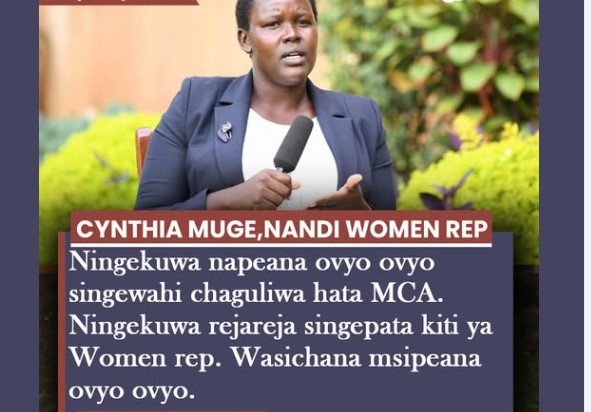
Women Representative Cynthia Muge has ignited public debate after advising young women to exercise discipline and self-respect, linking personal conduct to leadership and public perception. Speaking candidly, Muge argued that careless behavior can limit a woman’s chances of being taken seriously in politics and leadership.
According to Muge, if she had lived irresponsibly or developed a reputation for promiscuity, she believes she would never have risen through the political ranks. She stated that such behavior could have cost her the opportunity to become an MCA and later a Women Representative. Her message to young women was clear: personal choices matter, especially in societies where leaders are judged not only by competence but also by character.
Her remarks have received mixed reactions. Supporters agree with her position, saying that public leadership demands a high level of discipline, integrity, and self-control. They argue that politics, particularly for women, remains highly judgmental, and maintaining a respectable public image is often unavoidable for electoral success.
However, critics have accused Muge of reinforcing double standards that unfairly police women’s behavior while excusing men for similar conduct. They argue that leadership ability should be measured by ideas, service delivery, and integrity—not personal life choices. Some also feel her remarks risk shaming young women rather than empowering them.
Despite the controversy, Muge’s comments have reopened an important national conversation about gender, morality, and leadership in Kenya. They highlight the realities women face in public life, where scrutiny is often harsher and expectations higher.
Ultimately, the debate reflects a broader societal question: should personal morality determine leadership opportunities, or should competence and performance alone matter? As Kenya continues to push for gender equality in leadership, conversations like these—though uncomfortable—remain necessary.