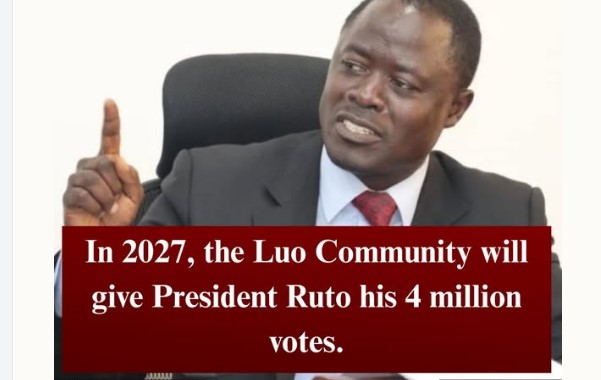
Peter Kaluma, a prominent politician from Western Kenya, recently made a bold prediction regarding the 2027 General Election, stating, “In 2027, the Luo Community will give President Ruto his 4 million votes.” His comments have sparked debate and discussion across political circles, given the historical voting patterns of the Luo community, which have traditionally favored opposition candidates.
Kaluma’s statement suggests a potential shift in political alignments, highlighting the possibility of broader support for President William Ruto beyond his traditional strongholds. By projecting that the Luo community could deliver significant votes, he is signaling confidence in Ruto’s outreach strategy and perceived appeal among communities previously seen as loyal to other political formations.
The remarks have elicited mixed reactions. Supporters of Ruto see Kaluma’s prediction as a sign of growing influence and cross-ethnic appeal, arguing that it reflects the president’s ability to connect with diverse communities and address their concerns. For them, it demonstrates that political loyalties can evolve based on leadership performance, policy decisions, and constituency engagement.
Critics, however, dismissed the comments as speculative, emphasizing that electoral outcomes are determined by complex factors including party alliances, candidates’ popularity, campaign strategies, and prevailing socio-economic conditions. They caution against assuming voting trends based solely on individual statements, noting that the Luo community has historically maintained consistent political preferences.
Regardless of public reactions, Kaluma’s declaration underscores the high stakes and strategic maneuvering shaping the road to 2027. It highlights the ongoing discussions about voter dynamics, ethnic influence, and coalition-building in Kenya, illustrating how political forecasts can spark conversation and influence public perception ahead of major elections.