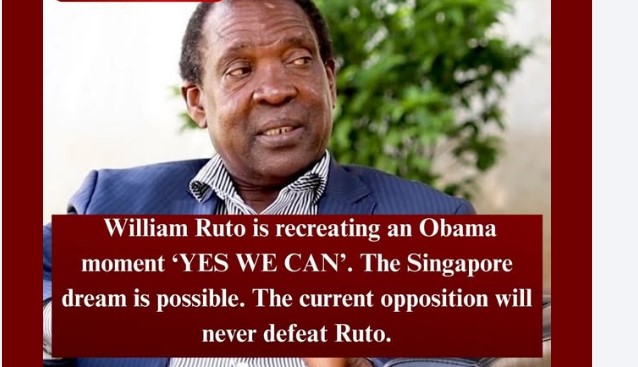
Political analyst Herman Manyora has once again stirred debate after drawing parallels between President William Ruto’s political momentum and former U.S. President Barack Obama’s famous “Yes We Can” movement. According to Manyora, Ruto is successfully crafting a powerful national narrative that blends optimism, belief, and ambition—one that convinces supporters that Kenya’s long-held “Singapore dream” is achievable under his leadership.
Manyora argues that political narratives often matter as much as policy details, especially in societies grappling with economic pressure and public frustration. In his view, Ruto’s messaging mirrors Obama’s ability to inspire hope during uncertain times. By consistently framing challenges as surmountable and positioning his leadership as a vehicle for transformation, Ruto taps into the psychology of aspiration, particularly among ordinary citizens who desire upward mobility and national progress.
Central to Manyora’s argument is the idea of the “Singapore dream”—the vision of Kenya transforming into a disciplined, efficient, and economically competitive state. While critics dismiss the comparison as unrealistic, Manyora insists that such dreams are not achieved through skepticism but through belief, long-term planning, and political stability. He suggests that Ruto’s administration is attempting to cultivate this mindset, encouraging citizens to see development as a shared national project rather than an abstract promise.
Manyora also delivers a blunt assessment of the opposition, asserting that in its current form, it lacks the coherence, strategy, and inspirational leadership needed to challenge Ruto effectively. He contends that fragmented messaging and internal rivalries have weakened the opposition’s ability to present a compelling alternative vision. Without unity or a clear national agenda, Manyora believes defeating an incumbent president who controls both narrative and state machinery will be extremely difficult.
However, the comparison to Obama and Singapore has not gone unchallenged. Critics argue that Kenya’s political, social, and economic realities are fundamentally different and that inspirational rhetoric must be matched by measurable outcomes. Rising costs of living, unemployment, and public dissatisfaction remain significant tests for Ruto’s leadership and could erode even the strongest political narratives if not addressed convincingly.
Ultimately, Herman Manyora’s remarks reflect a broader debate about the power of belief, leadership, and storytelling in politics. Whether President Ruto’s “Yes We Can” moment translates into lasting transformation or remains a persuasive slogan will depend on governance outcomes and public trust. What is clear is that as the 2027 election approaches, narrative, vision, and credibility will play a decisive role in shaping Kenya’s political future.