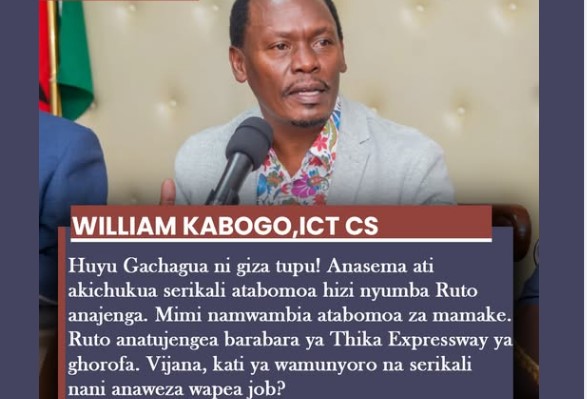
Former Kiambu Governor William Kabogo has launched a scathing attack on former Deputy President Rigathi Gachagua, accusing him of lacking a clear vision for the country and engaging in what he described as reckless political rhetoric. Kabogo’s remarks came in response to claims attributed to Gachagua that a future administration under him would demolish housing projects initiated by President William Ruto’s government.
Kabogo dismissed the statements as empty and destructive politics, saying that tearing down development projects does not amount to leadership. In a sharp retort, he mocked the demolition claims, arguing that such threats only reveal political bitterness rather than a workable plan for the nation. According to Kabogo, leadership should focus on building and improving livelihoods, not undoing projects meant to benefit citizens.
He went on to defend President Ruto’s development agenda, highlighting major infrastructure initiatives, including what he metaphorically referred to as an elevated or modernized Thika Expressway. Kabogo framed these projects as symbols of progress and long-term investment in economic growth, particularly for young people seeking employment opportunities.
Addressing the youth directly, Kabogo posed a pointed question: between individual politicians driven by personal ambition and a sitting government rolling out large-scale projects, who is more capable of creating jobs? He argued that government-led infrastructure and housing projects have a greater potential to absorb unemployed youth and stimulate the economy compared to political rhetoric with no clear execution plan.
Kabogo’s remarks have ignited debate within political circles, with critics accusing him of personal attacks, while supporters say he is simply calling out what they view as populist and unproductive opposition politics. The exchange reflects the growing tension as leaders position themselves ahead of future political contests.
The episode highlights a broader issue in Kenyan politics: the clash between development-focused narratives and confrontational political messaging. As the country grapples with unemployment and economic pressure, many Kenyans continue to demand leadership that prioritizes practical solutions over political theatrics.