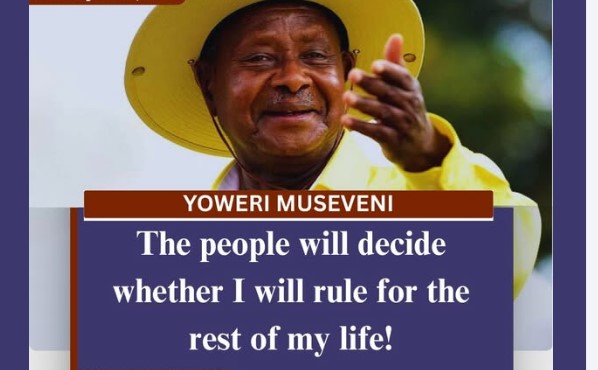
“The people will decide whether I will rule for the rest of my life,” President Yoweri Museveni once stated, a remark that has continued to provoke debate both within Uganda and beyond its borders. The statement reflects Museveni’s long-standing argument that his continued leadership is rooted in popular will rather than personal ambition.
Museveni has ruled Uganda for decades, making him one of Africa’s longest-serving leaders. Throughout his tenure, he has consistently emphasized elections as the ultimate measure of legitimacy. By asserting that the people will decide his political future, Museveni frames his leadership as a product of democratic choice, placing responsibility directly on voters rather than on constitutional limits or external pressure.
Supporters of the president interpret this statement as confidence in public support and political experience. They argue that continuity in leadership has brought stability, security, and economic progress, particularly in a region that has faced conflict and instability. From this perspective, longevity in office is seen not as a weakness but as evidence of trust repeatedly renewed through the ballot.
Critics, however, view the statement through a different lens. They argue that true democracy is not defined solely by elections, but also by strong institutions, peaceful transitions of power, and respect for term limits. To them, the idea of ruling “for the rest of my life” raises concerns about political stagnation, reduced competition, and the suppression of alternative leadership.
The statement also highlights a broader African political debate about leadership, succession, and governance. It raises questions about whether democracy should prioritize experience and continuity or renewal and institutional safeguards. In countries where leaders remain in power for extended periods, the balance between popular support and democratic principles remains a sensitive issue.
Museveni’s words ultimately place the spotlight on Ugandan voters and institutions. The credibility of elections, the independence of electoral bodies, and the freedom of political expression all become central in determining whether such a claim truly reflects the will of the people. As Uganda continues to navigate its political future, the statement remains a powerful symbol of the ongoing tension between authority, democracy, and popular choice.


