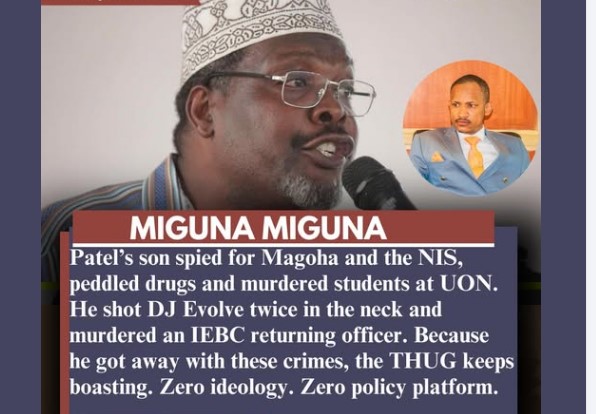
Kenyan lawyer and political commentator Miguna Miguna has launched a scathing attack on Member of Parliament Babu Owino, alleging a series of serious crimes and ethical violations. According to Miguna, Owino, whom he refers to as a “thug,” has a history of violence and lawlessness, including murder, drug involvement, and politically motivated surveillance.
In his statement, Miguna claims that Owino—referred to as “Patel’s son”—reportedly spied for former Education Cabinet Secretary George Magoha and the National Intelligence Service (NIS). He further alleges that Owino was involved in peddling drugs, murdering students at the University of Nairobi (UON), and shooting DJ Evolve twice in the neck. Miguna also accuses him of killing an Independent Electoral and Boundaries Commission (IEBC) returning officer.
According to Miguna, Owino’s ability to evade justice has emboldened him, allowing him to boast publicly without fear of consequences. He argues that despite holding a parliamentary seat, Owino lacks a coherent ideology or policy platform, reducing him to a figure who relies on intimidation, notoriety, and populist theatrics rather than principled leadership.
These allegations, if verified, would paint a troubling picture of political leadership and accountability in Kenya. They underscore the challenges of ensuring justice for alleged criminal behavior among public figures and highlight the intersection between politics, power, and impunity. Miguna’s remarks also contribute to the broader public discourse about the ethical responsibilities of elected officials, particularly those who wield significant influence over youth and urban communities.
Public reaction to Miguna’s accusations has been sharply divided. Supporters of Owino dismiss the claims as politically motivated attacks intended to tarnish his reputation, while critics of Owino argue that the allegations reflect longstanding concerns about his behavior and suitability for public office. Regardless of public opinion, the statements highlight the importance of rigorous legal scrutiny and investigative transparency in politically sensitive cases.
This confrontation also raises questions about how allegations of criminal behavior intersect with electoral politics. Voters are often faced with the challenge of balancing charismatic leadership, popular appeal, and moral integrity when choosing their representatives. In Kenya’s highly competitive political landscape, accusations such as those made by Miguna serve as a reminder of the need for accountability and oversight, both within political parties and in public office.
Ultimately, Miguna Miguna’s statement is a forceful critique of Babu Owino’s character and conduct, emphasizing the broader need for ethical leadership in Kenyan politics. Whether investigated formally or debated publicly, these claims add to ongoing discussions about governance, justice, and the moral responsibilities of elected officials in shaping the nation’s future.