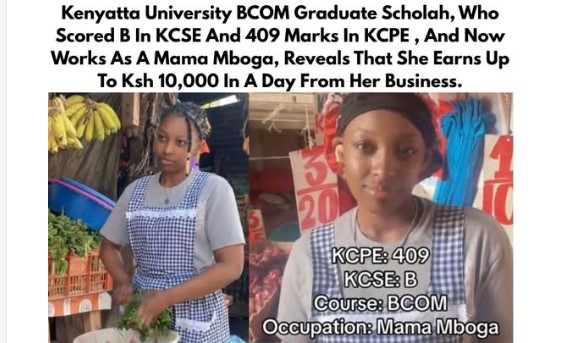
A Kenyatta University Bachelor of Commerce graduate has sparked widespread discussion after revealing that she earns up to Ksh 10,000 a day working as a mama mboga, challenging long-held beliefs about success, education, and employment in Kenya. Despite scoring a B in KCSE and 409 marks in KCPE—results many would associate with a promising white-collar future—her journey has taken a different but financially rewarding path.
Her story highlights the harsh realities facing many graduates in the country. With limited formal job opportunities and an increasingly competitive job market, academic excellence no longer guarantees employment. Like thousands of other graduates, she found herself forced to rethink traditional definitions of success and explore alternative means of earning a living.
Rather than viewing informal trade as a failure, the BCOM graduate embraced entrepreneurship at the grassroots level. By running a vegetable business, she has been able to generate consistent income, sometimes surpassing what many formally employed professionals earn in a month. Her revelation that she can make up to Ksh 10,000 in a single day has shocked many and forced a reevaluation of how society values different types of work.
Supporters of her decision argue that dignity lies in honest work, not job titles. They point out that entrepreneurship—whether formal or informal—plays a critical role in Kenya’s economy and provides livelihoods to millions. From this perspective, her success as a mama mboga is not a downgrade but a practical response to economic realities.
However, her story has also reignited concerns about the state of higher education and employment planning. Critics question why highly educated graduates are pushed into informal sectors, arguing that this reflects systemic failures in job creation, skills alignment, and economic planning. To them, her situation is both inspiring and troubling—a testament to resilience, but also a symptom of deeper structural issues.
The graduate herself represents a growing generation that prioritizes income and independence over societal expectations. Her journey challenges the stigma attached to informal work and encourages young people to think creatively about survival and success. In a time when unemployment remains high, her experience sends a powerful message: adaptability is just as important as education.
Ultimately, the story of the Kenyatta University BCOM graduate turned mama mboga forces Kenyans to confront uncomfortable truths about education, employment, and pride. It reminds society that success is not linear, and that honest work—regardless of form—can be both dignified and financially empowering in today’s economy.