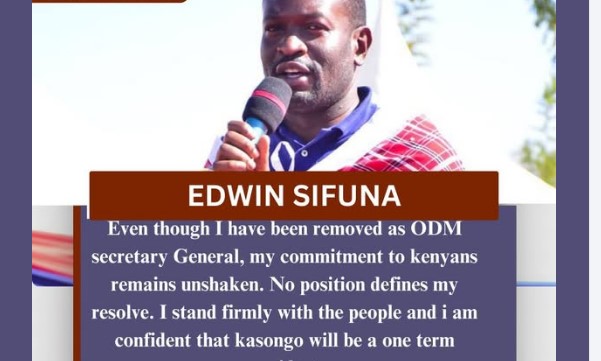
Former Orange Democratic Movement Secretary-General Edwin Sifuna has intensified political discourse in Kenya with a striking statement regarding President William Ruto’s tenure. Speaking to the media, Sifuna expressed unwavering confidence that Ruto, whom he referred to as “Kasongo,” will serve only a single term in office.
“I am confident that Kasongo will be a one-term president,” Sifuna declared, framing his prediction as both a critique of the current administration and a rallying call to opposition supporters. The statement highlights the growing rhetoric from opposition leaders, who continue to question the sustainability and legitimacy of Ruto’s political mandate. According to Sifuna, the electorate is increasingly aware of what he terms governance gaps and unmet expectations under the current leadership, which, in his view, will influence voter behavior in the next election.
Political commentators suggest that such pronouncements serve multiple purposes. First, they aim to energize the opposition base by presenting a vision of change and accountability. Second, they function as a strategic signal to undecided voters, emphasizing performance and tangible results as the measure of leadership rather than party loyalty or rhetoric. In this context, Sifuna’s remarks can be seen as an effort to frame the narrative early, shaping public perception ahead of the 2027 electoral cycle.
The comment also underscores the intensifying rivalry between the ruling party and opposition coalitions. Sifuna’s phrasing, using the nickname “Kasongo,” resonates with local political audiences, emphasizing familiarity while simultaneously critiquing the president’s leadership style. Analysts note that this personalization of political critique is common in Kenyan politics, where emotional appeal and relatability are often used to mobilize supporters.
Beyond electoral strategy, the statement reflects deeper ideological differences. Sifuna and other opposition leaders continue to call for governance based on accountability, transparency, and service delivery. By predicting a one-term presidency for Ruto, Sifuna is positioning the opposition as vigilant overseers of national leadership, insisting that the electorate will ultimately reward performance and penalize shortcomings.
As the political season progresses, statements like Sifuna’s are likely to dominate public discourse, intensifying scrutiny of government policies, electoral preparations, and campaign strategies. Whether the prediction materializes or remains a symbolic challenge, it highlights the high-stakes nature of Kenya’s evolving political landscape and the increasingly vocal role of opposition figures in shaping the narrative of leadership and governance.