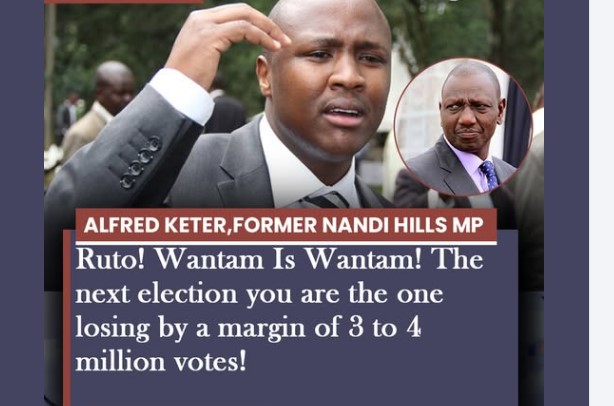
Former MP Alfred Keter has issued a bold political warning to President William Ruto, declaring that “Wantam is Wantam” and predicting that the president will lose the next election by a margin of three to four million votes. His remarks reflect growing political tensions and signal widening cracks within the ruling political establishment.
Keter’s statement taps into a popular political slogan that has gained traction among sections of the public who believe that President Ruto’s leadership should be limited to a single term. The phrase “Wantam” has evolved from a campaign chant into a broader expression of public dissatisfaction, driven largely by economic pressure, high taxation, and the rising cost of living.
By openly predicting a massive electoral defeat, Keter positions himself as a voice of dissent and a messenger of public anger. Such statements are not merely about numbers but are meant to communicate the scale of frustration among voters who feel betrayed by unfulfilled promises. Whether accurate or exaggerated, the claim underscores the intensity of opposition sentiments taking shape well before the next general election.
Political analysts note that early declarations like Keter’s are strategic. They aim to weaken the incumbent’s image of invincibility while energizing critics and opposition supporters. At the same time, they place pressure on the government to reassess its policies and reconnect with ordinary citizens.
While elections are ultimately decided at the ballot, rhetoric such as Keter’s highlights a critical reality in democratic politics: leaders who ignore public sentiment risk facing serious backlash. The coming years will test whether the government can reverse negative perceptions or whether the “Wantam” narrative will grow into a decisive political movement.