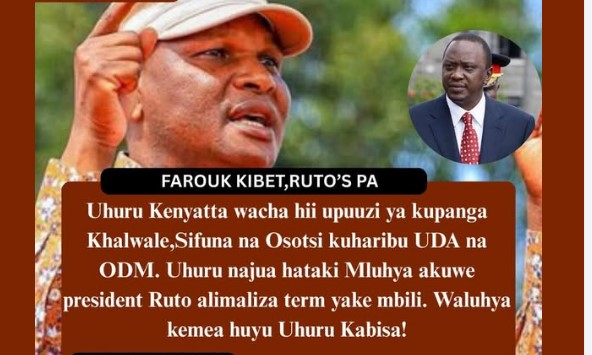
President William Ruto’s Personal Assistant has publicly criticized former President Uhuru Kenyatta, accusing him of interfering in party politics and attempting to influence the leadership dynamics within UDA and ODM. In a strongly worded statement, the PA addressed what he described as Uhuru’s alleged attempts to “plan” against certain political figures, naming Khalwale and Sifuna in his remarks.
The statement read in part, “Uhuru Kenyatta, wacha hii upuuzi ya kupanga Khalwale, Sifuna na Osotsi kuharibu UDA na ODM. Uhuru najua hataki Mluhya akuwe president baada Ruto alimaliza term yake mbili. Waluhya kemea huyu Uhuru kabisa!” The PA’s message implied that the former president was allegedly trying to prevent a candidate from the Luhya community from rising politically, sparking reactions among political analysts and the public.
Observers note that the exchange reflects ongoing tensions between Kenya’s current administration and some former political leaders, highlighting the complexities of inter-party relationships ahead of future elections. Analysts argue that such public disagreements could influence voter perceptions, particularly within key communities like the Luhya, who play a significant role in Kenya’s electoral politics.
Reactions to the statement have been mixed. Supporters of Ruto’s administration defended the PA’s remarks as a necessary pushback against what they see as undue interference, while critics cautioned that personal attacks and ethnic references risk deepening political divisions and undermining national cohesion.
The incident underscores the heated nature of political discourse in Kenya, especially as leaders prepare for the next electoral cycle. It also demonstrates the increasing role of close presidential aides in shaping public narratives and influencing political messaging.