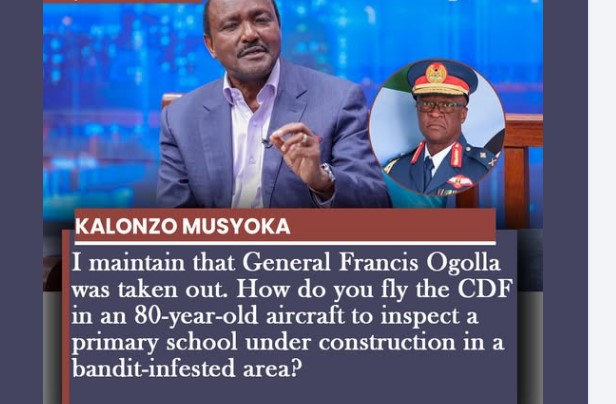
Wiper Party leader Kalonzo Musyoka has reignited public debate over the death of former Chief of Defence Forces (CDF) General Francis Ogolla after insisting that the circumstances surrounding the incident raise serious and unanswered questions. Speaking firmly, Kalonzo maintained his belief that General Ogolla was “taken out,” a claim that has drawn both concern and criticism across the political divide.
At the centre of Kalonzo’s argument is what he describes as a troubling contradiction in the official narrative. He questioned why a sitting CDF would be flown in what he termed an “80-year-old aircraft” to inspect a primary school project in a region known for banditry and insecurity. To Kalonzo, this decision defies both military logic and standard security protocols expected for a high-ranking officer of Ogolla’s stature.
Kalonzo’s remarks tap into a broader culture of public skepticism that often follows the deaths of senior national figures, especially when they occur under unusual or tragic circumstances. In Kenya, historical mistrust of state explanations has made such incidents fertile ground for speculation, with many citizens demanding transparency, accountability, and full disclosure beyond official statements.
However, government authorities and the military have previously emphasized that investigations were conducted according to established procedures, urging the public to avoid speculation that could undermine national stability or the integrity of state institutions. Critics of Kalonzo’s position argue that without concrete evidence, such claims risk fueling misinformation and unnecessary tension, particularly around sensitive national security matters.
Supporters of Kalonzo, on the other hand, argue that asking hard questions should not be dismissed as recklessness. They contend that scrutiny of state decisions—especially those involving the safety of top security officials—is a legitimate part of democratic accountability. From this perspective, Kalonzo’s insistence reflects a demand for deeper transparency rather than a definitive accusation.
Ultimately, Kalonzo Musyoka’s statement underscores the enduring tension between official explanations and public doubt in moments of national tragedy. Whether his claims will lead to renewed calls for independent review or fade into political rhetoric remains to be seen. What is clear, however, is that the death of General Francis Ogolla continues to evoke strong emotions and unresolved questions, highlighting the need for trust, clarity, and openness in matters of national importance.