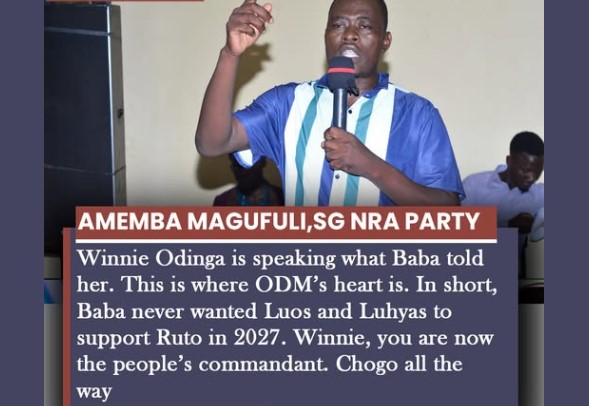
Winnie Odinga’s recent remarks have been widely interpreted as more than just personal opinion; to many supporters, they reflect the long-held position of Raila Odinga himself. Within ODM circles, her words are seen as a clear expression of where the party’s heart truly lies and what its long-term political direction looks like as the 2027 general election approaches.
For years, Raila Odinga—fondly referred to as Baba—has been viewed as a cautious strategist who prefers measured political messaging. However, his stance has often been understood implicitly rather than stated openly. The belief that he never wanted Luos and Luhyas to align politically with President William Ruto in 2027 has circulated quietly among ODM supporters. Winnie’s bold articulation of this position has therefore been taken as a moment of clarity rather than defiance, reinforcing what many consider Baba’s unspoken truth.
ODM’s traditional support base has always been anchored in collective identity, shared political history, and perceived struggles for inclusion and justice. Any suggestion of supporting Ruto’s leadership has been viewed by sections of the party as a betrayal of that legacy. Winnie’s message appears to reaffirm that ODM’s political soul remains firmly rooted in opposition politics, resistance, and the preservation of its core voter base rather than short-term political convenience.
Her emergence as a vocal figure has also elevated her status within the movement. Supporters now frame her as “the people’s commandant,” a symbolic title that speaks to leadership, courage, and ideological clarity. This moment marks a generational shift, where younger voices within ODM are no longer content with coded language but are willing to state positions plainly, even when they provoke controversy.
The phrase “Chogo all the way” captures the emotional energy behind this stance. It is not merely a slogan but a declaration of political loyalty and direction. It signals a refusal to dilute ODM’s identity or realign its support away from its historical mission. For many, Winnie’s words restore a sense of confidence that the party has not lost its way amid shifting alliances and political bargaining.
As the road to 2027 unfolds, Winnie Odinga’s voice is likely to remain influential, not because she speaks loudly, but because many believe she speaks with Baba’s blessing. Whether this strengthens ODM’s unity or sharpens political divisions, it has unmistakably clarified where the party stands—and where it does not.