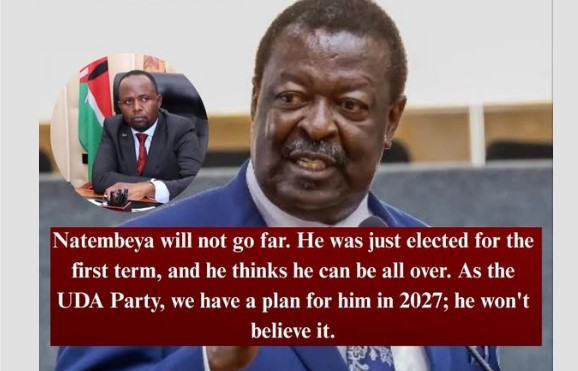
Prime Cabinet Secretary Musalia Mudavadi has escalated political tensions in the Rift Valley and Western Kenya regions after issuing a stern warning to Trans Nzoia Governor George Natembeya. In unusually sharp language for the soft-spoken PCS, Mudavadi declared that Natembeya “will not go far,” adding that although the governor is only serving his first term, he already “thinks he can be all over.” Mudavadi went further, hinting at a calculated political plot within the UDA Party: “We have a plan for him in 2027; he won’t believe it.”
With these words, Mudavadi openly signals the beginning of an intense political confrontation—one that is likely to shape Western Kenya’s voting patterns and redefine alliances ahead of the 2027 elections. His warning is not accidental; it is strategic, deliberate, and aimed at curbing Natembeya’s growing national influence.
Natembeya has recently emerged as one of the most outspoken governors in the country. His bold criticism of senior politicians, fiery speeches, and rising popularity have made him a political force—especially among youth and marginalized communities who see him as a refreshingly fearless leader. But his assertive style has also drawn resistance from established political heavyweights who feel threatened by his rapid rise.
Mudavadi’s statement therefore reflects a deeper political anxiety: a new wave of leadership is challenging old structures, and Natembeya is at the center of that disruption.
By warning that UDA already has a plan for him in 2027, Mudavadi exposes the ruling party’s intentions to neutralize Natembeya before he gains too much ground. This could involve fielding a strong opponent, targeted political messaging, attempts to weaken his grassroots networks, or broader strategies designed to diminish his national appeal.
But the PCS’s remarks also raise questions about political freedom and internal democracy. Should a governor be punished for expressing his views? Should national leaders seek to suppress rising voices simply because they don’t fit into the existing political hierarchy? Mudavadi’s tone suggests that politics in Kenya remains a fiercely territorial game where ambition must be “licensed” by established power centers.
Natembeya, on the other hand, has positioned himself as a reformist outsider—unapologetic, fearless, and willing to confront what he sees as outdated political behaviour. His clashes with top leaders signal a generational shift, a new style of politics that is direct, provocative, and unfiltered.
Mudavadi’s warning marks the opening of what may become one of the most closely watched political rivalries heading into 2027. It is a fight between an established national statesman and a rising political rebel; between UDA’s well-organized machinery and Natembeya’s raw grassroots momentum.
Ultimately, the statement reveals more than just a threat—it is a glimpse into the fierce battles, alliances, and strategies already shaping Kenya’s future political landscape. The war lines have been drawn, and both sides now appear ready for a long, bruising contest.