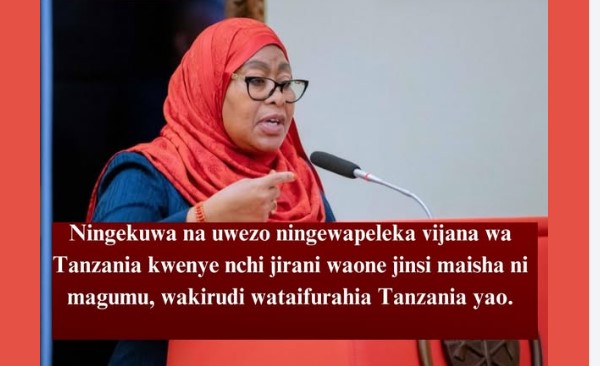
Tanzanian President Samia Suluhu Hassan has sparked a nationwide conversation after stating that if she had the ability, she would take Tanzanian youth to neighboring countries so they can witness firsthand how tough life can be elsewhere. According to Suluhu, many young people in Tanzania often underestimate the progress the country has made, largely because they have not experienced the harsher conditions faced by citizens in other regions.
“Ningekuwa na uwezo ningewapeleka vijana wa Tanzania kwenye nchi jirani waone jinsi maisha ni magumu,” Suluhu said. She added that once the youth return home after seeing those challenges, “wakirudi wataifurahia Tanzania yao.”
The President emphasized that Tanzania, despite its challenges, has enjoyed relative stability, security, and economic progress compared to several neighboring nations. She argued that some young people take these advantages for granted, focusing only on hardships within the country without appreciating the broader regional reality.
Suluhu’s remarks appear to be a response to growing complaints from sections of the youth who feel burdened by unemployment, slow economic growth, and rising living expenses. She insisted that while the government is working to improve opportunities for young people, it is also important for them to understand that Tanzania is still doing better than many countries facing more severe instability and economic struggles.
Her statement has triggered mixed reactions online. Supporters praised her for speaking frankly, saying the youth need exposure beyond their borders to understand the value of peace and stability. Others, however, argued that instead of comparing Tanzania to struggling countries, the government should focus on creating an environment that allows young people to thrive locally.
Critics also pointed out that telling youths to appreciate Tanzania because others have it worse may downplay valid concerns about unemployment, cost of living, and limited opportunities. They insisted that young people deserve solutions—not comparisons.
Even with the debate, Suluhu’s message has highlighted a recurring theme in her leadership: encouraging Tanzanians to recognize what the country has achieved while pushing for unity and patience as the government continues addressing economic and social challenges.