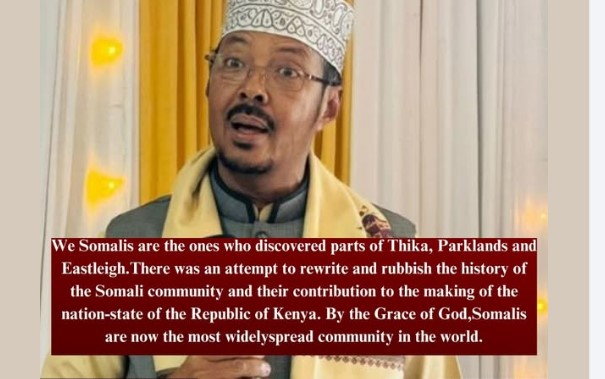
Eldas Member of Parliament Adan Keynan has reignited a national conversation on Kenya’s cultural history after asserting that the Somali community played a crucial role in the development of several key urban areas, including Thika, Parklands and Eastleigh. Speaking during a public forum, Keynan criticized what he termed as attempts to “rewrite and rubbish” the historical contributions of Somalis to the Kenyan nation-state.
Keynan stated that long before modern urban planning and commercial expansion, Somali traders, pastoralists and business families were among the first to settle and invest in the expansion of these now-thriving regions. According to him, the presence of Somali communities in these areas helped to stimulate commerce, establish trade routes and attract diverse populations—ultimately contributing to the multicultural identity of modern Kenya. He emphasized that this history should not be erased or minimized, but instead acknowledged as part of the broader national story.
The MP went further to highlight the global spread and resilience of Somali people, describing them as one of the most widely dispersed communities in the world today. Through entrepreneurship, migration, and cultural preservation, Somalis have established strong economic and social footprints both within Kenya and across continents. Keynan argued that this global dispersal reflects not only adaptability but also the strength and unity of Somali identity.
His remarks have drawn mixed reactions. Supporters praised Keynan for defending cultural recognition and historical truth, noting that the Somali community—like many others—has significantly shaped the country’s economic development, especially through trade and real estate. Eastleigh, for example, has grown into one of Kenya’s most vibrant commercial hubs largely due to Somali investment and enterprise.
Critics, however, cautioned that framing the history of certain regions as being “discovered” by one community risks oversimplifying Kenya’s diverse and intertwined historical narratives. They argue that Kenya’s urban and cultural evolution has been a collective effort involving many communities, migrants, and generations.
Nonetheless, Keynan’s statement underscores the ongoing debate about cultural identity, historical recognition, and nation-building in Kenya. As the country continues to embrace its multicultural fabric, discussions like these are essential in ensuring all communities feel seen and appreciated for their contributions. The MP’s call to acknowledge Somali history serves as a reminder that Kenya’s strength lies in its diversity—and in the stories of all its people.