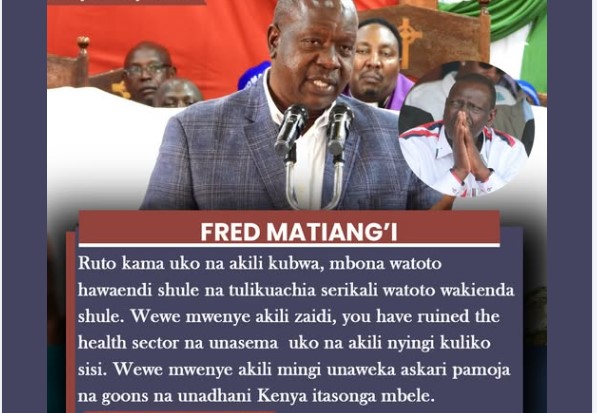
Cabinet Secretary George Matiang’i has launched a sharp critique of President William Ruto, challenging claims about his intelligence and leadership effectiveness. In a pointed statement, Matiang’i questioned why, despite Ruto’s purported cleverness, issues such as school attendance remain unresolved. He stated, “Ruto kama uko na akili kubwa, mbona watoto hawaendi shule na tulikuachia serikali watoto wakienda shule. Wewe mwenye akili zaidi, you have ruined the health sector na unasema uko na akili nyingi kuliko sisi.”
Matiang’i’s criticism highlights concerns over service delivery in key sectors like education and healthcare. By referencing declining school attendance and perceived challenges in the health system, he points to areas where governance outcomes have not met public expectations. His remarks suggest that effective leadership should be measured not by rhetoric or claims of intelligence but by tangible improvements in citizens’ lives.
Additionally, Matiang’i condemned the deployment of security forces in ways he considers excessive, stating, “Wewe mwenye akili mingi unaweka askari pamoja na goons na unadhani Kenya itasonga mbele.” This critique frames certain government actions as counterproductive, implying that reliance on force rather than effective policy solutions undermines national progress.
The exchange reflects the growing political tensions and accountability debates within Kenya’s leadership. As leaders assert influence and defend their records, public scrutiny of governance outcomes becomes central to political discourse. Matiang’i’s statements reinforce the expectation that political authority must translate into improved services and citizen welfare rather than simply projecting power.
Ultimately, his remarks serve as both a critique of current policies and a broader call for leaders to prioritize effective governance over image or political theatrics.