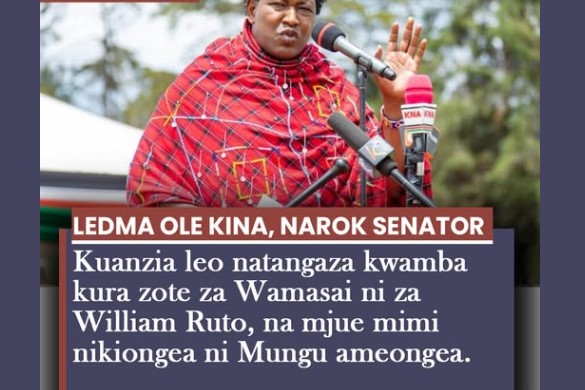
Narok Senator Ledama Ole Kina has sparked fresh political debate after declaring that all votes from the Maasai community belong to President William Ruto. In a bold and controversial statement, the outspoken senator asserted that when he speaks, it is as though God Himself has spoken, a remark that immediately drew widespread public attention.
Ole Kina’s declaration highlights the growing political competition for the support of key communities as the country gradually looks ahead to the 2027 General Election. The Maasai community, spread across several counties, is considered politically significant, and leaders often seek to position themselves as influential voices capable of mobilizing its vote. By openly backing President Ruto, Ole Kina signaled a clear political alignment that could shape future alliances in the region.
However, the senator’s claim to speak on behalf of the entire community has generated mixed reactions. Critics argue that voting is a personal democratic right and that no individual leader can authoritatively decide how an entire community should vote. Supporters, on the other hand, view his remarks as symbolic political rhetoric meant to demonstrate confidence and loyalty rather than a literal command.
The reference to divine authority further intensified the conversation, with some Kenyans questioning the appropriateness of invoking God in political declarations. Religious leaders and political analysts often caution against blending faith and politics too closely, warning that such statements can polarize the public and overshadow substantive policy discussions.
As Kenya’s political climate continues to evolve, Ole Kina’s remarks serve as a reminder of how bold statements and strong language remain powerful tools in shaping public discourse. Whether his declaration will translate into actual voting patterns remains to be seen, but it has undoubtedly added momentum to the ongoing political conversation.


