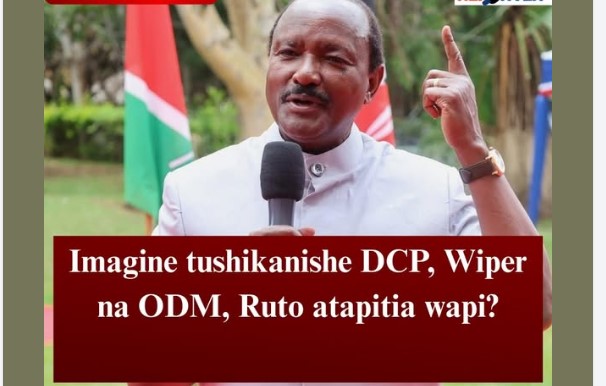
Wiper Party leader and former Vice President Kalonzo Musyoka has once again reignited political debate with a statement hinting at a possible grand opposition coalition against President William Ruto ahead of the 2027 General Election. Speaking to the media, Kalonzo said, “Imagine tushkanishe DCP, Wiper na ODM, Ruto atapitia wapi?”—raising the prospect of uniting multiple opposition forces to challenge the incumbent president.
Kalonzo’s comment refers to a potential alliance between the Democratic Party of Kenya (DCP), Wiper, and the Orange Democratic Movement (ODM). By combining their political strength, resources, and voter bases, such a coalition could present a formidable challenge to Ruto’s Kenya Kwanza Alliance. The Wiper leader’s rhetorical question—“where will he go?”—underscores his belief that a united opposition could significantly limit the president’s electoral options.
The statement comes amid increasing speculation about the opposition’s strategy for 2027. Opposition parties have faced internal disagreements, leadership tensions, and questions about who could effectively counter Ruto’s growing political machinery. Kalonzo’s remarks appear aimed at reassuring supporters that a strategic coalition could consolidate voter power, particularly in regions traditionally loyal to ODM, Wiper, and smaller allied parties.
Political analysts suggest that the Wiper leader’s comments are as much about signaling intent as they are about testing public reception to coalition talks. Historically, Kenyan elections have been shaped by alliances that cut across ethnic and regional lines, and Kalonzo seems aware that opposition fragmentation benefits the ruling party. By openly discussing potential collaboration, he positions himself as a key player in shaping the opposition’s path forward.
Reactions to Kalonzo’s statement have been mixed. Supporters of the opposition praised him for articulating a vision of unity, emphasizing that only coordinated efforts can pose a credible challenge to President Ruto. Critics, however, dismissed the comment as aspirational rhetoric, noting that past coalition efforts in Kenya have often faltered due to leadership disputes and conflicting ambitions.
Ultimately, Kalonzo’s question—“Ruto atapitia wapi?”—highlights both the stakes of the 2027 election and the central role of political strategy in determining outcomes. Whether the suggested coalition will materialize or remain a talking point, the statement underscores the high level of maneuvering and negotiation already underway as parties position themselves for one of the most anticipated elections in Kenya’s history.