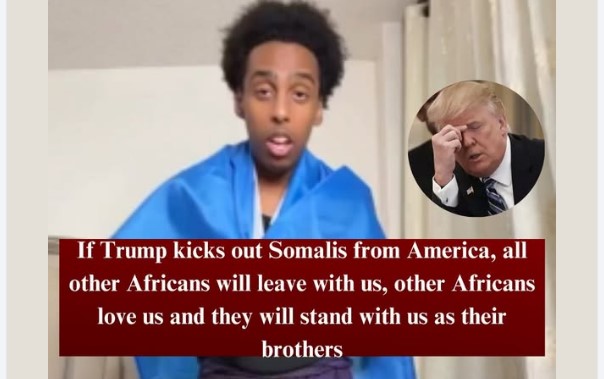
A Somali man has sparked widespread online discussion after issuing a bold warning to former U.S. President Donald Trump over remarks and policies seen as hostile toward Somali immigrants. In a passionate statement circulating on social media, he claimed that if Trump were ever to expel Somalis from the United States, “all other Africans will leave with us.” According to him, Africans across the continent share a deep bond with Somalis and would never allow the community to face discrimination or deportation alone.
His remarks come amid renewed debates over immigration policies in the U.S., especially rhetoric targeting African and Muslim-majority nations. Somalis, many of whom arrived in America as refugees fleeing conflict, have built vibrant communities in states like Minnesota, Ohio, and Washington. They contribute to business, culture, academia, and local economies. The man argued that attempts to single out Somalis would be met with united resistance, not only from the broader African diaspora but from Americans who value diversity and fairness.
Supporters of his message applauded the spirit of Pan-African unity he expressed. They noted that African communities abroad often rely on one another for support, cultural connection, and solidarity in the face of discrimination. To them, the warning served as a reminder that an attack on one group is felt by many others who share similar migration experiences and challenges.
However, critics said the statement was symbolic rather than literal, arguing that each immigrant community faces its own unique legal and political circumstances. They also pointed out that American immigration policy does not operate collectively by continent, making the idea of mass voluntary departure highly unlikely. Nevertheless, they agreed that the sentiment reflects a growing awareness of shared identity among African communities living abroad.
The viral message highlights broader themes of belonging, identity, and unity within the African diaspora. For many immigrants, threats of deportation or exclusion touch on deep fears rooted in historical struggles. At the same time, such statements reveal an increasing sense of confidence and cohesion among African communities, who feel empowered to challenge rhetoric that seeks to marginalize them.
Ultimately, the Somali man’s warning is less about literal action and more about symbolic solidarity. It emphasizes that African immigrants, regardless of their country of origin, see themselves as brothers and sisters bound by shared history, challenges, and aspirations. As debates around immigration continue in the U.S., such expressions of unity signal that immigrant communities are not isolated voices—they are interconnected networks standing together in the fight for dignity and fair treatment.