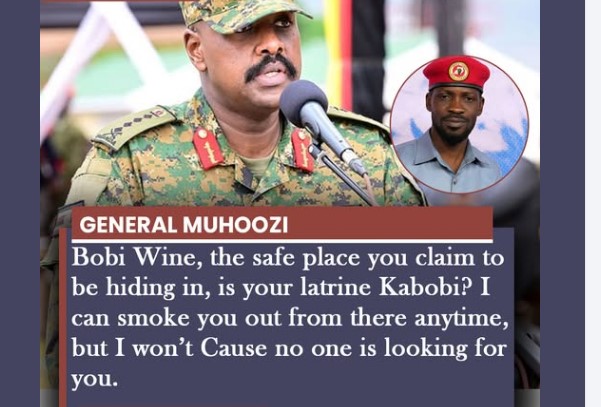
In recent remarks that have In recent remarks that have stirred political chatter, General Muhoozi Kainerugaba, Uganda’s influential military figure, directed a biting message to opposition leader Bobi Wine. According to Muhoozi, the location where Bobi Wine claims to be hiding is nothing more than “a latrine in Kabobi.” He warned that while he could “smoke him out” at any time, he chooses not to, emphasizing that the opposition leader is effectively ignored by the public.
Muhoozi’s statement comes amid ongoing political tensions in Uganda, where the government has often clashed with Bobi Wine’s camp over election disputes and security concerns. The choice of words highlights not only a personal disdain but also a broader attempt to undermine Bobi Wine’s credibility and perceived influence.
The metaphorical framing of Bobi Wine’s hideout as a “latrine” underscores the sharpness of Muhoozi’s critique, blending insult with political commentary. By asserting that “no one is looking for” the opposition leader, Muhoozi paints a picture of irrelevance, suggesting that Bobi Wine’s political maneuvers fail to resonate with the public or pose any real threat.
This interaction illustrates the intense rhetoric that continues to characterize Ugandan politics, where political figures frequently use pointed language to assert dominance or discredit opponents. For observers, it raises questions about the strategies both sides employ to sway public opinion, especially as the country navigates the delicate dynamics between incumbents and opposition voices.
In conclusion, General Muhoozi’s warning to Bobi Wine is more than a personal attack—it is a strategic statement aimed at diminishing the opposition leader’s standing while reinforcing the narrative of control and authority by the current political establishment. Such statements are likely to fuel further debate and keep Uganda’s political scene sharply in focus.political chatter, General Muhoozi Kainerugaba, Uganda’s influential military figure, directed a biting message to opposition leader Bobi Wine. According to Muhoozi, the location where Bobi Wine claims to be hiding is nothing more than “a latrine in Kabobi.” He warned that while he could “smoke him out” at any time, he chooses not to, emphasizing that the opposition leader is effectively ignored by the public.
Muhoozi’s statement comes amid ongoing political tensions in Uganda, where the government has often clashed with Bobi Wine’s camp over election disputes and security concerns. The choice of words highlights not only a personal disdain but also a broader attempt to undermine Bobi Wine’s credibility and perceived influence.
The metaphorical framing of Bobi Wine’s hideout as a “latrine” underscores the sharpness of Muhoozi’s critique, blending insult with political commentary. By asserting that “no one is looking for” the opposition leader, Muhoozi paints a picture of irrelevance, suggesting that Bobi Wine’s political maneuvers fail to resonate with the public or pose any real threat.
This interaction illustrates the intense rhetoric that continues to characterize Ugandan politics, where political figures frequently use pointed language to assert dominance or discredit opponents. For observers, it raises questions about the strategies both sides employ to sway public opinion, especially as the country navigates the delicate dynamics between incumbents and opposition voices.
General Muhoozi’s warning to Bobi Wine is more than a personal attack—it is a strategic statement aimed at diminishing the opposition leader’s standing while reinforcing the narrative of control and authority by the current political establishment. Such statements are likely to fuel further debate and keep Uganda’s political scene sharply in focus.