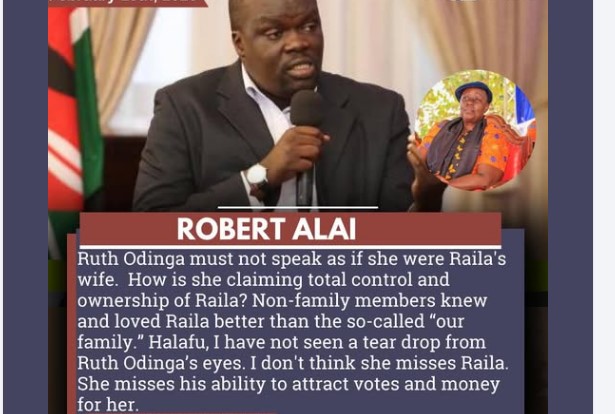
Political activist Robert Alai has ignited debate after sharply criticizing Ruth Odinga over her public remarks concerning her brother, veteran opposition leader Raila Odinga.
In his statement, Alai questioned what he described as Ruth Odinga’s tone and posture when speaking about Raila, arguing that no individual should appear to claim exclusive ownership or control over a public figure whose political journey has involved millions of supporters. He went further to suggest that loyalty and affection for Raila extend far beyond immediate family, adding emotionally charged remarks about her public demeanor.
The comments have drawn mixed reactions. Some agree with Alai’s broader argument that Raila’s political legacy belongs to a wide movement, not just his relatives. Raila Odinga has, over decades, built a strong national following, with supporters who feel deeply invested in his struggles and achievements. For many, his influence transcends family boundaries.
Others, however, see Alai’s remarks as unnecessarily personal. Grief, political loyalty, and public communication are complex matters. People express emotions differently, and it is often difficult to judge what someone feels based solely on public appearances. Public figures, especially family members of prominent leaders, may also navigate sensitive situations carefully to avoid misinterpretation.
The controversy reflects a larger issue in Kenyan politics: the delicate balance between family influence and public ownership of political legacies. Political dynasties have long shaped the country’s landscape, and questions about who speaks for whom often trigger intense debate.
Ultimately, while robust political discussion is part of democracy, personal attacks risk shifting focus away from substantive issues. Conversations about leadership, legacy, and representation may be more productive when centered on ideas and public interest rather than perceived personal motives.