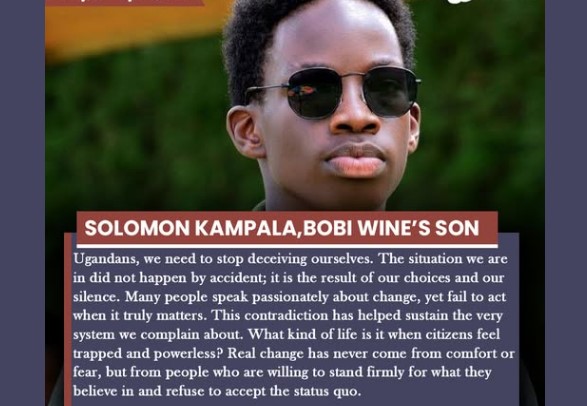
Solomon Kampala, the 20-year-old son of Ugandan opposition leader Bobi Wine, has drawn attention after delivering a blunt and reflective message to Ugandans about responsibility, silence, and the cost of inaction. His words cut through emotional rhetoric and instead challenge citizens to look inward, arguing that the country’s current struggles are not accidental but largely self-inflicted through choices made and opportunities ignored.
At the heart of Solomon’s message is accountability. He rejects the idea that Uganda’s situation is purely the fault of leaders alone, insisting that silence and passivity among citizens have played a major role in sustaining the system they criticize. By pointing out the contradiction between loudly demanding change and failing to act when it matters, he exposes a painful truth: complaining without action becomes a form of cooperation with the status quo.
His statement also speaks to the psychological toll of prolonged political stagnation. When citizens feel trapped and powerless, hope slowly erodes, and fear replaces courage. Solomon questions whether such an existence can truly be called life, highlighting how loss of agency is one of the most damaging effects of long-term repression. This sense of helplessness, once normalized, becomes a powerful tool for maintaining control.
Importantly, Solomon emphasizes that real change has never emerged from comfort or fear. History shows that meaningful transformation often comes at a cost and requires people willing to take risks, stand firm, and endure discomfort. By reminding Ugandans of this reality, he challenges a culture of caution that prioritizes personal safety over collective progress.
Coming from a young person, the message carries added weight. It reflects the frustration of a generation that has grown up knowing only one political reality and is increasingly unwilling to accept excuses. Solomon Kampala’s words are not merely criticism; they are a call to conscience. They urge Ugandans to align their words with action and to recognize that the power to shape the future, though risky to exercise, cannot be surrendered without consequence.
In the end, his lecture is less about blame and more about awakening. It asks a difficult but necessary question: if change is desired, who is truly willing to stand up for it?