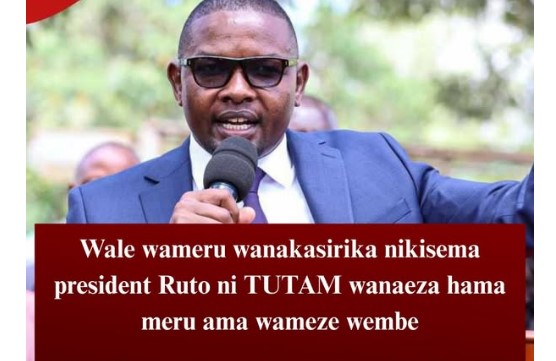
Mutuma M’Ethingia has ignited fresh political debate following controversial remarks he made concerning President William Ruto and reactions from members of the Meru community. While addressing supporters during a public forum, Mutuma claimed that some individuals from Meru often react angrily whenever he refers to President Ruto using the term “TUTAM,” a slang expression commonly used by critics to ridicule the head of state. According to Mutuma, such reactions demonstrate intolerance toward dissenting political opinions.
In his remarks, Mutuma appeared unapologetic, asserting that those offended by his statements had the option of either leaving Meru or learning to live with opposing views. His words, delivered in a blunt and confrontational tone, immediately attracted attention, with many interpreting them as a reflection of the deep political divisions currently shaping the country’s discourse. The comments have since circulated widely on social media, where they have triggered intense discussion among supporters and critics alike.
Some of Mutuma’s supporters argue that his remarks highlight the importance of free speech and the right of leaders to openly criticize the government without fear of backlash. They contend that political debate should allow room for strong language, especially in a climate where many Kenyans are frustrated by rising living costs, unemployment, and unmet campaign promises. To them, Mutuma’s comments resonate with citizens who feel ignored and marginalized by the current administration.
However, critics have strongly condemned the remarks, describing them as inflammatory and disrespectful to the Meru community. They argue that such statements risk fueling ethnic tension and undermining national unity at a time when leaders should be promoting dialogue and cohesion. Political analysts have also warned that the use of provocative language may deepen divisions and distract from substantive discussions on policy and governance.
The incident underscores the increasingly sharp tone of Kenya’s political conversations, where frustration with leadership often manifests in aggressive rhetoric. As the country edges closer to the next electoral cycle, observers note that public figures will likely continue to face scrutiny over their language and conduct, especially when addressing sensitive ethnic and political issues.