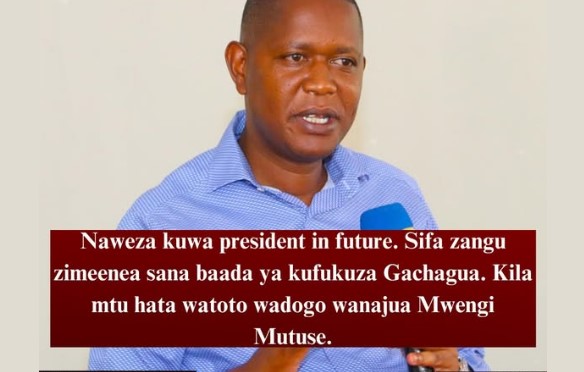
Kaiti MP Mwengi Mutuse has stirred fresh political conversation after boldly declaring that he has what it takes to become Kenya’s president in the future. Mutuse, who has recently gained national visibility, says his name has spread widely across the country—so much so that even young children now recognize him. According to him, his political rise accelerated significantly after the dramatic confrontation that led to the ejection of Deputy President Rigathi Gachagua from a public event.
Mutuse’s statement reflects the growing confidence among a new crop of youthful leaders who believe they can compete at the highest levels of national politics. In recent months, Mutuse has positioned himself as outspoken, fearless, and unafraid to challenge senior political figures. His claim that he could one day ascend to the presidency underscores the shifting political landscape, where fresh voices are increasingly stepping forward and asserting their place.
Supporters argue that Mutuse’s boldness represents the new political energy Kenya needs—leaders who are vibrant, unapologetic, and willing to stand up against what they see as entrenched political interests. They say the fact that his name is now widely recognized is proof that he is connecting with ordinary citizens and capturing public attention in a crowded political field.
However, critics view his statement as premature and overly ambitious. They argue that popularity alone is not enough to propel someone to the presidency. Kenya’s political environment is complex and often influenced by tribal alliances, party structures, national experience, and long-term networks that take years to build. To them, Mutuse’s growing fame does not automatically translate into national leadership readiness.
Despite the differing opinions, there is no doubt that Mwengi Mutuse has become a notable figure in Kenya’s political discussions. His willingness to speak openly about his ambitions illustrates his confidence in his rising influence. Whether or not his dream of becoming president becomes a reality, his statement has already sparked conversations about generational change, political courage, and the evolving identity of Kenya’s leadership.
Mutuse’s remarks suggest that he sees himself not just as a local MP but as a national figure with potential to shape the country’s future. And as long as he continues to command public attention—whether through bold statements or controversial political moments—he is likely to remain part of Kenya’s unfolding political narrative.