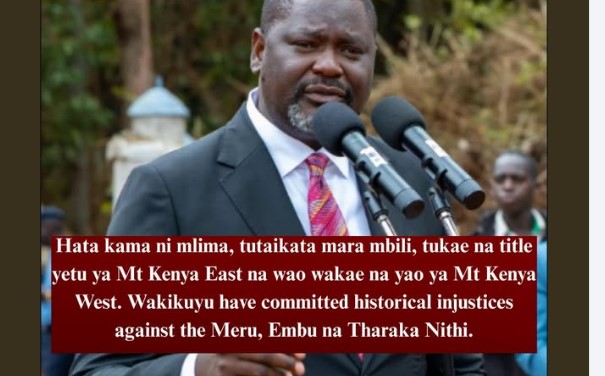
Tension has risen within Mount Kenya politics following explosive remarks by Cabinet Secretary Ruku, who accused Kikuyu leaders of committing historical injustices against the Meru, Embu, and Tharaka Nithi communities. His comments, which suggested a symbolic political split of the Mount Kenya region into East and West, have triggered anxiety and sharp reactions, particularly among Kikuyu political circles.
CS Ruku’s statement reflects long-simmering grievances within the broader Mount Kenya bloc. For years, leaders from Mount Kenya East have complained of political marginalization, uneven development, and dominance by Mount Kenya West in national decision-making. By invoking the idea of “cutting the mountain into two,” Ruku was not necessarily calling for physical division, but emphasizing the desire for recognition, equity, and political autonomy for the eastern counties.
The accusation of historical injustices against Meru, Embu, and Tharaka Nithi touches on a sensitive subject. These communities have often argued that despite being part of the larger Mount Kenya identity, their interests have been sidelined, especially in high-level appointments, resource allocation, and political bargaining. Ruku’s remarks bring these frustrations into the national spotlight, forcing a conversation many leaders have preferred to avoid.
Reactions from Kikuyu leaders and residents have been swift, with some expressing alarm at what they view as divisive rhetoric. Critics argue that such statements risk fracturing Mount Kenya unity at a time when regional cohesion is seen as crucial for political influence. They warn that public airing of ethnic grievances could weaken the bloc’s bargaining power and deepen internal mistrust.
Others, however, interpret Ruku’s comments as a bold expression of truth rather than an attempt to divide. Supporters argue that unity should not come at the expense of fairness and that genuine cohesion can only be built by acknowledging past imbalances. From this perspective, confronting uncomfortable realities is a necessary step toward equitable representation and shared progress.
The episode highlights the fragile nature of ethnic and regional alliances in Kenyan politics. While Mount Kenya is often treated as a single political unit, internal differences based on history, identity, and access to power continue to shape its dynamics. Leaders who challenge the dominant narrative risk backlash, but also resonate with communities that feel unheard.
Ultimately, CS Ruku’s remarks have reignited debate about justice, inclusion, and representation within Mount Kenya politics. Whether the conversation leads to deeper divisions or meaningful reforms will depend on how leaders respond—through dialogue and reconciliation, or through denial and political defensiveness. As Kenya moves toward future elections, managing such internal tensions will be critical to maintaining both regional stability and national unity.