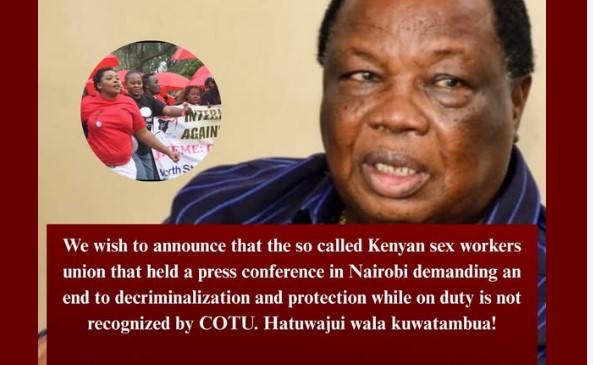
COTU Secretary-General Francis Atwoli has stirred controversy after issuing sharp remarks dismissing a newly formed workers’ alliance, declaring that it has no recognition or legitimacy under the Central Organization of Trade Unions (COTU). Speaking during a public engagement, Atwoli described the group in harsh terms, stating that COTU neither acknowledges nor recognizes its existence, adding that its leadership and objectives remain unknown to the federation.
Atwoli maintained that COTU is the only legally mandated umbrella body representing workers’ interests in Kenya and emphasized that any parallel organization operating outside its framework lacks credibility. He argued that established labor structures exist to protect workers’ rights and warned against groups he claimed were formed for political or personal interests rather than genuine labor advocacy. His remarks appeared aimed at discouraging workers from associating with organizations that, according to him, could mislead or exploit them.
The comments quickly attracted public attention, triggering debate among labor rights activists, politicians, and members of the public. Supporters of Atwoli defended his position, saying it was necessary to protect workers from confusion and fragmentation within the labor movement. They argued that unauthorized unions weaken collective bargaining power and undermine decades of progress achieved through organized labor under COTU.
However, critics faulted Atwoli’s choice of words, describing them as unnecessarily aggressive and dismissive. Some labor experts warned that such rhetoric could alienate workers who feel unrepresented or dissatisfied with existing unions. Others argued that growing economic pressures and rising unemployment have pushed workers to seek alternative platforms to voice their concerns, highlighting a broader crisis within the labor movement.
The incident reflects ongoing tensions within Kenya’s labor sector as economic challenges intensify and workers demand stronger representation. As debates over union leadership, accountability, and relevance continue, observers note that the future of organized labor will depend on its ability to adapt, engage inclusively, and address the real struggles facing workers across the country.