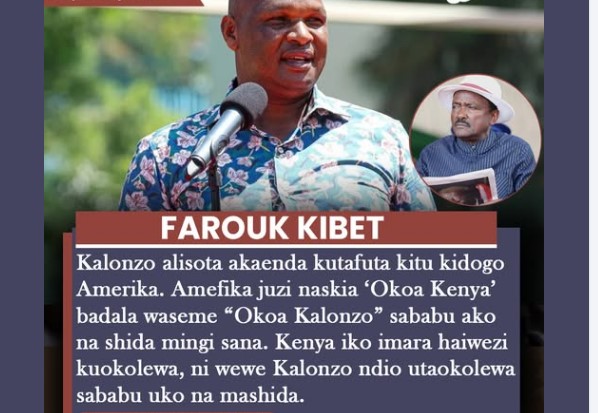
Nairobi politics has been thrown into the spotlight once again after Nandi County legislator Farouk Kibet mocked Kalonzo Musyoka in a scathing critique of his recent political moves.
In his remarks, Kibet ridiculed Kalonzo’s overseas activities, saying, “Kalonzo alisota akaenda kutafuta kitu kidogo Amerika. Amefika juzi naskia ‘Okoa Kenya’ badala waseme ‘Okoa Kalonzo’ kwa sababu ako na shida mingi sana.” He argued that Kenya does not need saving, asserting that the country is already stable and resilient. According to Kibet, any talk of “rescuing” the nation should instead focus on Kalonzo himself, whom he described as facing significant personal and political challenges.
The legislator’s comments come amid speculation over Kalonzo’s ambitions and his messaging strategy, particularly regarding public campaigns framed around national salvation themes. By highlighting perceived contradictions in Kalonzo’s approach, Kibet appears to question the credibility and seriousness of his leadership narrative.
Analysts note that such public mockery is indicative of the intense rivalry and personalization of political discourse in Kenya. Leaders increasingly use pointed remarks to sway public opinion, portray opponents as flawed, and consolidate support within their own bases.
The statement also reflects broader debates within the opposition space over leadership capability, strategy, and the role of symbolic gestures versus substantive policy proposals. Kibet’s critique may resonate with voters who are skeptical of politically symbolic actions, emphasizing the need for measurable results and tangible leadership.
As the political landscape continues to evolve, exchanges like this underscore the high stakes of public perception, media framing, and the increasingly combative tone characterizing Kenya’s political discourse.