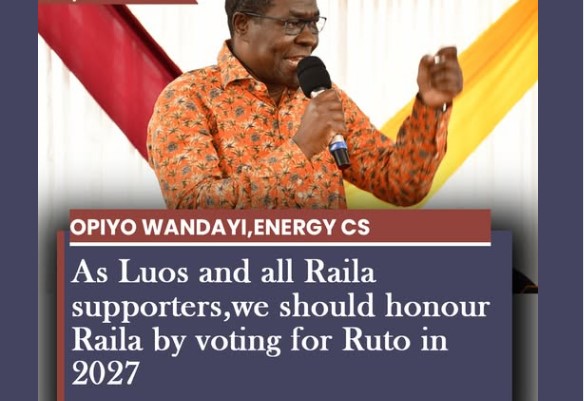
Opiyo Wandayi’s statement urging Luos and Raila Odinga’s supporters to back President William Ruto in the 2027 general election has ignited intense debate across Kenya’s political landscape. His remarks come at a time when the country is still adjusting to shifting alliances and redefining political loyalty in the post–Raila Odinga era, making his call both controversial and consequential.
According to Wandayi, supporting President Ruto is not an act of betrayal but a gesture of honour toward Raila Odinga’s political legacy. He argues that Raila spent decades advocating for national unity, democratic reforms, and inclusive governance, often making personal sacrifices for the sake of the country. From this perspective, Wandayi suggests that following Raila’s broader vision of stability and coexistence means embracing pragmatic politics rather than permanent opposition.
Wandayi’s position reflects a growing school of thought within parts of the ODM support base that believes continued political isolation would be harmful to the Luo community and Raila’s longtime supporters. Proponents of this view argue that engaging with the sitting government offers an opportunity to influence policy, secure development, and protect the interests of communities that have historically felt excluded from state power. For them, cooperation is framed as strategic realism rather than political surrender.
However, the statement has also attracted sharp criticism. Many Raila supporters view President Ruto as a political rival whose rise symbolized the defeat of ODM’s long-standing ambitions. To such critics, voting for Ruto contradicts the spirit of resistance and reform that Raila championed for years. They argue that Raila’s legacy should be preserved through ideological consistency, not political accommodation.
The debate sparked by Wandayi’s remarks highlights a deeper question facing Kenyan politics: whether loyalty should be rooted in personalities or principles. As generational change reshapes the electorate, voters are increasingly forced to choose between emotional allegiance and strategic calculation. Wandayi’s message challenges supporters to redefine what it truly means to honour a political icon in a rapidly evolving political environment.
Ultimately, Opiyo Wandayi’s call underscores the fluid nature of Kenyan politics, where alliances are rarely permanent and political survival often demands adaptation. Whether his appeal will resonate with Raila’s supporters remains uncertain, but it has undeniably reopened conversations about legacy, loyalty, and the future direction of Kenya’s opposition politics as the 2027 election approaches.