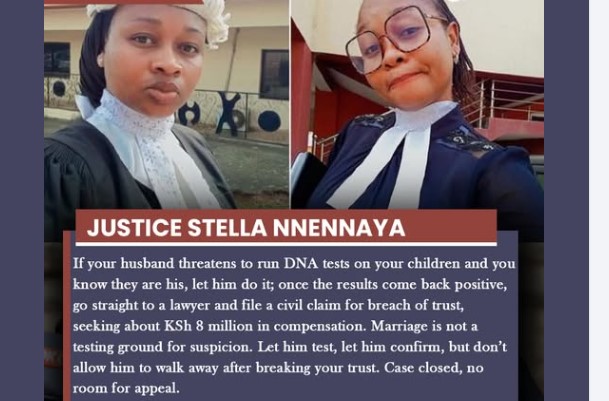
A lady lawyer has ignited intense online debate after advising women to take legal action against husbands who demand DNA tests, even when the children are biologically theirs. Her argument is bold: if a man insists on DNA testing out of suspicion, and the results confirm paternity, the wife should sue for breach of trust and seek hefty compensation. According to her, marriage is not a testing ground for doubt, and suspicion itself is a punishable wrong.
The statement resonates with many women because it touches on a painful reality. Accusations of infidelity, especially when tied to children, can be deeply humiliating and emotionally damaging. For a wife who knows she has been faithful, a DNA demand may feel like character assassination. From this perspective, the lawyer’s advice reframes DNA testing not as a neutral scientific act, but as an act that fractures trust and dignity within marriage.
However, the argument also raises complex legal and social questions. Marriage is built on trust, but it also exists within a framework of rights, fears, and human insecurity. Some men request DNA tests due to past trauma, societal narratives, or external pressure rather than proven wrongdoing by their partners. Turning every suspicion into a multi-million-shilling lawsuit risks escalating private marital conflicts into adversarial legal battles that may permanently destroy families.
Legally, the claim of “breach of trust” is not as straightforward as the lawyer suggests. Kenyan civil law requires proof of actual harm—emotional distress, reputational damage, or financial loss—not just wounded feelings. While a lawsuit is possible, presenting it as automatic, guaranteed, and “case closed” oversimplifies the law and may mislead the public into believing courts operate on emotion rather than evidence.
Socially, the advice reflects a growing shift toward using law as a weapon in intimate relationships. While accountability is important, marriage also demands communication, counseling, and maturity. If every suspicion is met with litigation, couples may replace dialogue with threats, deepening mistrust instead of resolving it.
Ultimately, the lawyer’s remarks have succeeded in one major way: they have sparked an overdue conversation about respect, trust, and boundaries in marriage. DNA testing should not be used casually or as a tool of intimidation. At the same time, legal action should be a last resort, not the first response to marital insecurity. A healthy marriage cannot survive on tests and courtrooms alone; it requires honesty, empathy, and mutual respect from both partners.