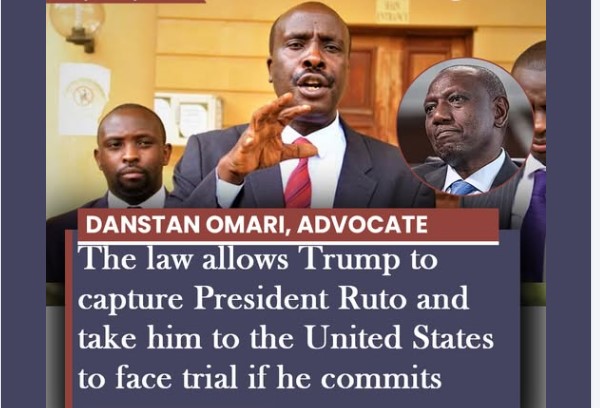
Renowned Kenyan lawyer Danstan Omari has sparked public debate after making a bold legal claim suggesting that former United States President Donald Trump could lawfully order the arrest or capture of Kenyan President William Ruto under certain circumstances.
Speaking during a legal discussion, Omari argued that international law and U.S. domestic statutes grant the American president wide-ranging powers, particularly in matters related to national security, international crimes, and foreign policy enforcement. According to him, these legal frameworks could, in theory, be used to justify the arrest of a foreign leader if specific conditions are met.
Omari emphasized that such actions would not be arbitrary but would rely on existing legal instruments, including international arrest warrants, sanctions regimes, or allegations involving crimes that fall under universal jurisdiction. He noted that powerful nations often use legal and diplomatic mechanisms to pursue individuals they consider a threat to their interests or global stability.
However, legal experts and political analysts caution that such scenarios are highly complex and rare. Arresting a sitting president would involve diplomatic immunity, international treaties, cooperation between states, and the approval of relevant international bodies. In most cases, such matters are handled through international courts or multilateral agreements rather than unilateral action.
Omari’s remarks have generated mixed reactions among Kenyans. Some view his comments as a realistic assessment of global power dynamics, while others believe the statement exaggerates the reach of U.S. law and undermines principles of state sovereignty.
Ultimately, the discussion has reignited broader conversations about international law, global politics, and the limits of power among world leaders. While Omari’s claim remains a legal opinion rather than an established fact, it highlights how interconnected and politically sensitive international legal systems have become in the modern world.