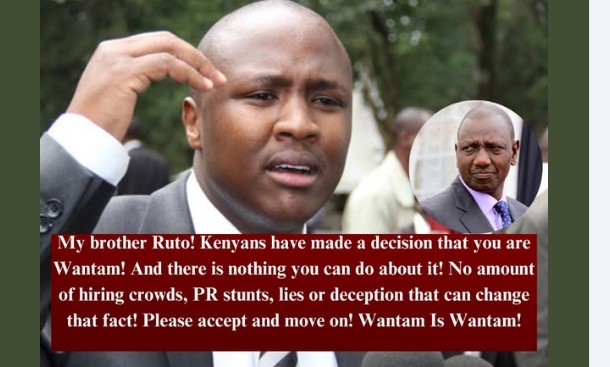
Senator Alfred Keter has made a forceful statement directed at President William Ruto, in which he appears to mock and challenge the president’s public image and political influence. In his remarks, Keter asserted that Kenyan citizens have already formed a clear judgment, labeling Ruto as “Wantam,” a term suggesting stubbornness or ineffectiveness, and insisted that no amount of political maneuvering can alter public perception.
Keter emphasized that strategies such as hiring crowds, staging public relations events, or engaging in misleading narratives are insufficient to sway the electorate’s opinion. By framing his message this way, he sought to underscore what he sees as the enduring gap between Ruto’s public portrayal and the citizens’ perception of his leadership.
The statement comes amid a highly charged political climate, where leaders and commentators often engage in direct and personal attacks to assert dominance or rally support. Keter’s rhetoric reflects not only criticism of Ruto’s political tactics but also a broader challenge to his legitimacy and ability to command public trust.
Political analysts note that such declarations, while dramatic, highlight the growing polarization in Kenyan politics. They serve both as a warning to those in power and as a tool for opposition figures to energize their supporters. The language used—combining mockery, accusation, and finality—reinforces the intensity of contemporary political discourse.
While some view Keter’s statement as purely symbolic or performative, others argue it signals deeper dissatisfaction among certain political circles and segments of the electorate. As the political narrative continues to evolve, exchanges like these illustrate the extent to which public perception, rhetoric, and image management influence the dynamics of Kenyan leadership and governance.