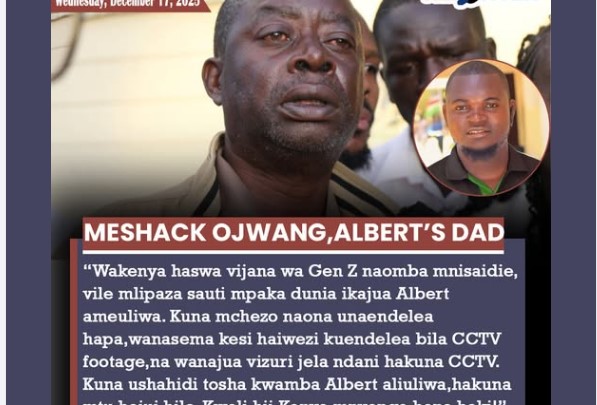
Albert Ojwang’s father has made an emotional public appeal to Kenyan youth, particularly Generation Z, urging them not to relent in their demand for justice following the death of his son. In a passionate statement, he recalled how young people previously raised their voices until the world took notice of Albert’s case, crediting their activism with bringing national and international attention to the matter.
Expressing deep frustration, Ojwang’s father claimed there are attempts to frustrate the case by citing the absence of CCTV footage as a reason proceedings cannot move forward. He questioned this reasoning, arguing that authorities are well aware that CCTV cameras are not installed inside prison cells, yet are still using this as a technical excuse. According to him, such arguments point to a broader effort to derail justice rather than uncover the truth.
He maintained that, in his view, there is sufficient evidence indicating that Albert did not die naturally, insisting that the circumstances surrounding his death are widely known. While investigations and legal processes are still ongoing, his statement reflects the anguish of a parent who feels that the system is failing those without power or influence.
The grieving father used his appeal to highlight what he described as a long-standing injustice in Kenya, where ordinary citizens often struggle to obtain fairness from institutions meant to protect them. His words echoed a sentiment shared by many families who feel marginalized and unheard when confronting authority.
As public interest in the case continues, his call places renewed pressure on young people, civil society, and human rights groups to remain vigilant. The statement has reignited debate about accountability, transparency, and whether justice in Kenya truly serves all citizens equally, or whether, as he lamented, the weak are left without protection.