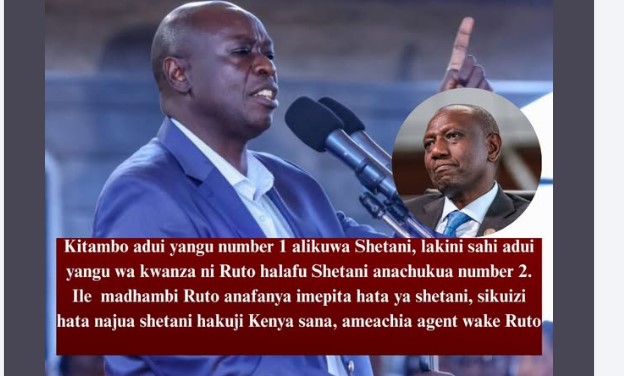
Deputy President Rigathi Gachagua has made a startling statement, claiming that President William Ruto’s actions surpass even those of the devil in terms of wrongdoing. Speaking candidly during a public rally, Gachagua declared, “Kitambo adui yangu number 1 alikuwa Shetani, lakini sahi adui yangu wa kwanza ni Ruto halafu Shetani anachukua number 2. Ile madhambi Ruto anafanya imepita hata ya shetani.” In his view, Ruto’s misdeeds are so significant that even the devil is relegated to second place, with the president’s agents acting on his behalf in Kenya.
Gachagua’s remarks appear to stem from frustration over internal political conflicts and perceived betrayals within the ruling coalition. By comparing Ruto’s actions to those of the devil, he is emphasizing both the magnitude of his grievances and the sense of moral outrage he feels. His comments suggest that he sees the current political leadership as engaging in behavior that is harmful to the nation and contrary to ethical standards.
The statement has drawn widespread attention and sparked heated debates online and in political circles. Supporters of Gachagua argue that his remarks highlight the need for accountability and integrity at the highest levels of government. They view his criticism as a wake-up call, urging citizens and political actors to scrutinize leadership decisions and actions closely.
Critics, however, have dismissed the comments as hyperbolic and politically motivated, arguing that such comparisons risk undermining constructive discourse and could polarize public opinion. Some also note that framing political disagreements in terms of morality and “good versus evil” can distract from substantive policy debates.
Regardless of interpretation, Gachagua’s statement underscores the intense rivalries and factionalism that characterize Kenyan politics, especially within the ruling Kenya Kwanza Alliance. His bold declaration positions him as a vocal critic of the president, signaling possible tensions and realignments as political actors prepare for the 2027 General Election.
Ultimately, Gachagua’s comments are both a personal critique and a broader political message, highlighting grievances, mobilizing supporters, and questioning leadership ethics at the highest level. Whether this rhetoric will translate into political action or remain a dramatic statement remains to be seen, but it has undoubtedly captured public attention.