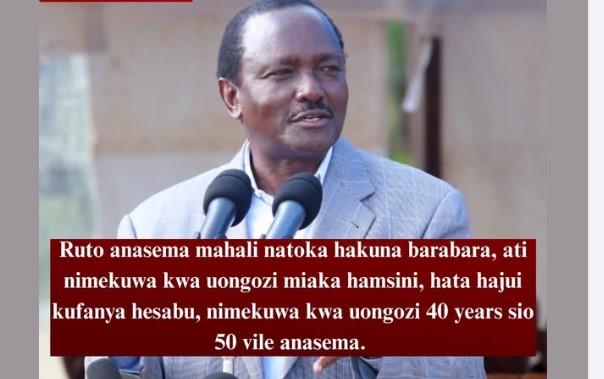
Wiper Party leader Kalonzo Musyoka has hit back at President William Ruto following remarks that questioned his leadership record and development legacy. Kalonzo dismissed Ruto’s claims as misleading, accusing the President of exaggeration and poor grasp of facts, particularly on the length of his time in leadership and the state of infrastructure in his home region.
Speaking in response, Kalonzo took issue with Ruto’s assertion that the area he comes from lacks roads and that he has been in leadership for over fifty years. According to Kalonzo, such statements are not only inaccurate but also careless. He clarified that his time in leadership spans about forty years, not fifty as alleged, and questioned how a sitting President could misstate such basic details.
At the core of Kalonzo’s response is a broader frustration with what he views as deliberate political distortion. He argues that reducing long-serving leaders to simplistic narratives ignores their contributions and unfairly shapes public perception. By correcting the record, Kalonzo sought to defend his political legacy while also casting doubt on the credibility of Ruto’s criticism.
The exchange reflects the growing tension between the government and opposition figures as political temperatures continue to rise. Infrastructure development, leadership longevity, and regional equity have become recurring themes in national discourse, often used as tools to either discredit rivals or mobilize political support. In this context, Ruto’s remarks and Kalonzo’s rebuttal are less about arithmetic and more about political positioning.
Supporters of Kalonzo argue that leadership experience should not be weaponized as a weakness, especially when it comes with institutional knowledge and a history of public service. They contend that development challenges cannot be pinned on individuals alone, as they are shaped by successive governments, budget priorities, and national planning decisions.
On the other hand, critics maintain that long years in leadership invite scrutiny and accountability. From this perspective, questions about development outcomes are legitimate, and veteran politicians must be prepared to defend their record without taking offense.
Ultimately, Kalonzo’s response underscores a deeper political struggle over narrative control. As Kenya moves closer to another election cycle, such exchanges are likely to intensify, with facts, figures, and past records becoming central weapons in the battle for public trust. Whether this debate resonates with voters will depend not on who counts years better, but on who convincingly addresses the country’s pressing economic and development concerns.