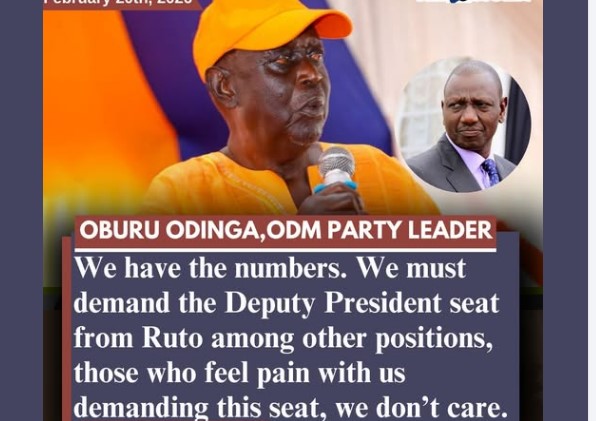
Senior ODM leader Oburu Odinga has boldly stated that his faction possesses sufficient political backing to demand the Deputy President position from President William Ruto, alongside other key government roles.
Speaking during a public gathering, Oburu said, “We have the numbers. We must demand the Deputy President seat from Ruto among other positions. Those who feel pain with us demanding this seat, we don’t care.” His remarks reflect a firm stance on power-sharing negotiations within the broad-based government arrangement and signal that ODM is unwilling to compromise on what it considers its fair share of top political offices.
Political analysts note that Oburu’s declaration comes at a time when alliances within Kenya Kwanza and the opposition are being tested, with leaders positioning themselves ahead of the 2027 General Election. By openly stating that his group has the numbers, Oburu appears to be signaling to both allies and rivals that ODM intends to play a decisive role in shaping the next government formation.
Observers also highlight that such a public assertion could heighten tensions between the ruling coalition and opposition leaders, particularly as negotiations over power-sharing and representation continue behind closed doors. Some commentators believe that this move is intended to strengthen ODM’s bargaining power and to publicly demonstrate political confidence, while others warn it may fuel friction among coalition partners who feel sidelined by the party’s assertiveness.
Oburu’s statement underscores the growing importance of internal party strength, negotiation leverage, and grassroots mobilization in Kenya’s evolving political landscape. As the country inches closer to the 2027 elections, leaders like Oburu are increasingly using both public platforms and strategic alliances to secure influential positions and assert their authority within the political hierarchy.