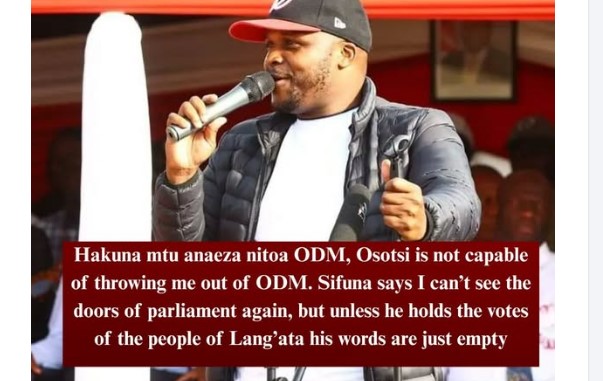
Lang’ata Member of Parliament Felix Odiwuor, popularly known as Jalang’o, has once again made headlines following his bold remarks defending his position within the Orange Democratic Movement (ODM). In his statement, “Hakuna mtu anaeza nitoa ODM. Osotsi is not capable of throwing me out of ODM. Sifuna says I can’t see the doors of parliament again, but unless he holds the votes of the people of Lang’ata his words are just empty,” Jalang’o expresses his frustration and defiance toward perceived attempts by ODM leadership to sideline or expel him. His words capture not only his confidence but also the complex dynamics within Kenyan party politics.
At the core of Jalang’o’s statement is a struggle for political legitimacy. By declaring that no one can remove him from ODM, he positions himself as a loyal member who refuses to be intimidated by party officials. His defiance stems from recent tensions within ODM, where some leaders accused him of associating too closely with President William Ruto and the Kenya Kwanza government—an act considered disloyal by the opposition party. Jalang’o, however, maintains that his political allegiance remains intact and that his relationship with the government is purely developmental, aimed at serving his constituents in Lang’ata.
Jalang’o’s reference to Edwin Sifuna and Osotsi reflects the internal friction between elected leaders and party officials. Sifuna, the ODM Secretary-General, had reportedly suggested that Jalang’o might not return to parliament under the party’s ticket. In response, Jalang’o argues that such threats are meaningless unless Sifuna controls the voters of Lang’ata. This remark underscores a key reality in Kenyan politics: power ultimately lies with the electorate, not with party elites. By invoking the will of the people, Jalang’o appeals directly to his constituents, reinforcing the idea that political survival depends more on voter confidence than on party approval.
Moreover, Jalang’o’s defiance can be seen as a symbol of growing independence among younger politicians in Kenya. Unlike the older generation, who often strictly adhere to party lines, new leaders like Jalang’o are more pragmatic. They prioritize development and collaboration across party divides, even if it means facing disciplinary action. This approach reflects a shift in Kenya’s political culture—one that values results and service delivery over rigid partisanship.
However, Jalang’o’s stance is not without risks. ODM remains one of the most influential political parties in Kenya, and open defiance of its leadership can lead to political isolation. The party’s disciplinary mechanisms could still be invoked against him, and his ability to secure the ODM ticket in future elections may be jeopardized. Yet, his confidence suggests he is willing to take that risk, banking on his popularity and direct connection with voters in Lang’ata.
Jalang’o’s statement reveals much about the changing dynamics of party politics in Kenya. His defiance of ODM leadership highlights a growing tension between party loyalty and personal political identity. It also underscores the increasing importance of voter-driven politics, where leaders seek to maintain legitimacy through direct engagement with constituents rather than through party structures. Whether his strategy will secure his political future remains to be seen, but one thing is clear: Jalang’o has positioned himself as a bold, independent voice in a political landscape dominated by party hierarchies.