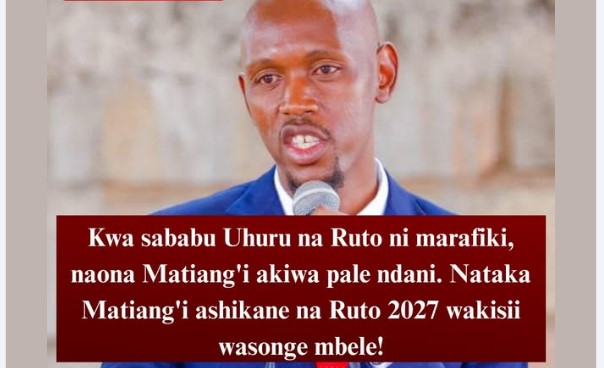
Political analyst Geoffrey Mosiria has weighed in on the evolving political landscape ahead of Kenya’s 2027 general elections, highlighting the potential role of Interior Cabinet Secretary Fred Matiang’i in shaping regional dynamics. Mosiria emphasized that the longstanding friendship between President Uhuru Kenyatta and Deputy President William Ruto creates an environment in which strategic alliances are likely to influence electoral outcomes.
“Because Uhuru and Ruto are friends, I see Matiang’i playing a key role. I want Matiang’i to align with Ruto in 2027 so that Kisii can move forward,” Mosiria stated. His remarks suggest that he views Matiang’i as a figure capable of bridging political interests and delivering strong support for Ruto in the Kisii region.
According to Mosiria, Matiang’i’s alignment with Ruto could serve multiple purposes. Beyond consolidating political power, it could help streamline governance efforts and ensure that local communities benefit from coordinated development initiatives. In Mosiria’s view, such collaboration would not only enhance Ruto’s electoral prospects but also provide a platform for Matiang’i to leverage his administrative experience and public influence to foster regional growth.
The analyst also highlighted the importance of regional loyalty and strategic partnerships in Kenya’s complex political environment. With the 2027 elections approaching, he believes that careful alliance-building will be crucial in mobilizing support, especially in areas where voter preferences are fluid and highly competitive.
Mosiria’s commentary underscores the expectation that political relationships forged at the national level—such as that between Uhuru and Ruto—can have far-reaching implications for local political actors like Matiang’i. By aligning with established leadership, regional players may strengthen their positions while also contributing to broader political stability and electoral success.
In conclusion, Mosiria’s observations point to a calculated approach to political strategy, where alliances, loyalty, and timing are critical factors. He urges that Matiang’i’s involvement in supporting Ruto be seen not only as a political maneuver but also as an opportunity for Kisii to advance and benefit from effective leadership and governance.