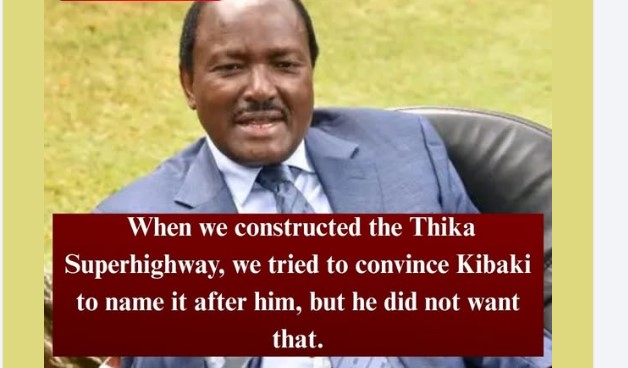
Wiper Party leader Kalonzo Musyoka has offered a revealing insight into the leadership style of former President Mwai Kibaki, recalling how efforts to name the Thika Superhighway after him were firmly declined. According to Kalonzo, those involved in the construction of the landmark infrastructure project believed it would be fitting to honour Kibaki’s role in transforming Kenya’s road network, but the former president was not interested in attaching his name to the project.
Kalonzo’s account paints a picture of a leader who preferred substance over symbolism. The Thika Superhighway remains one of the most significant infrastructure achievements in Kenya’s history, dramatically improving transport, boosting economic activity, and reshaping Nairobi and its surroundings. Yet, despite its scale and impact, Kibaki reportedly chose not to personalize the project, reflecting his reputation as a low-key technocrat focused more on delivery than personal recognition.
The revelation has reignited public discussion about leadership humility and legacy in Kenyan politics. In an era where large projects are often branded around sitting leaders, Kibaki’s reluctance to name the highway after himself stands in sharp contrast to modern political culture, where visibility and credit-taking are common. For many observers, Kalonzo’s story reinforces the perception of Kibaki as a leader who believed development projects belonged to the people, not individuals.
Kalonzo’s remarks also subtly highlight how political values and leadership styles evolve over time. While some leaders view naming projects as a way of cementing legacy, others see it as unnecessary self-promotion. Kibaki’s decision suggests that he believed his legacy would speak through results rather than titles or monuments.
Ultimately, the Thika Superhighway continues to serve millions of Kenyans daily, long after Kibaki’s presidency. Kalonzo Musyoka’s reflection reminds the country that impactful leadership is not always about being celebrated by name, but about building structures that endure and improve lives—whether or not they carry the name of the person who made them possible.