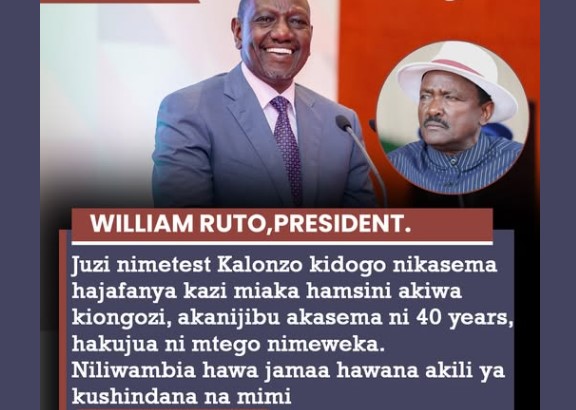
President William Ruto has stirred fresh political debate after making remarks that appeared to mock Wiper Party leader Kalonzo Musyoka, questioning his long record in leadership. While addressing supporters, Ruto narrated what he described as a calculated exchange in which he challenged Kalonzo over his years in public office, using the moment to cast doubt on the opposition’s effectiveness and political sharpness.
According to Ruto, he deliberately exaggerated the number of years Kalonzo has been in leadership, only for Kalonzo to correct him by stating a slightly lower figure. The president portrayed this response as falling into a “trap,” which he used to argue that the opposition lacks the strategic thinking needed to compete with him politically. His remarks were delivered in a light, mocking tone, drawing laughter from his audience while sharpening the political jab.
The comments reflect the increasingly combative nature of Kenya’s political discourse, where leaders often use ridicule and personal attacks to undermine their rivals. By focusing on Kalonzo’s long political career, Ruto sought to reinforce a narrative that opposition figures represent old politics with little to show in terms of tangible achievements, contrasting this with his own image as a decisive and results-oriented leader.
However, critics argue that such statements risk lowering the tone of national politics and shifting focus away from substantive issues affecting citizens, such as the cost of living, unemployment, and governance. Supporters of Kalonzo have previously defended his experience, pointing to his long service as evidence of institutional knowledge and contribution to the country’s democratic journey.
Ruto’s remarks also highlight the broader strategy of framing political competition as a contest of intelligence and competence rather than policy. This approach, while effective in energizing supporters, often deepens political divisions and fuels hostility between rival camps.
As Kenya moves forward in a politically charged environment, exchanges like these underscore the challenge of balancing sharp political messaging with respectful discourse. While political rivalry is inevitable, many Kenyans continue to call for debates that prioritize ideas, accountability, and solutions over personal mockery and taunts.