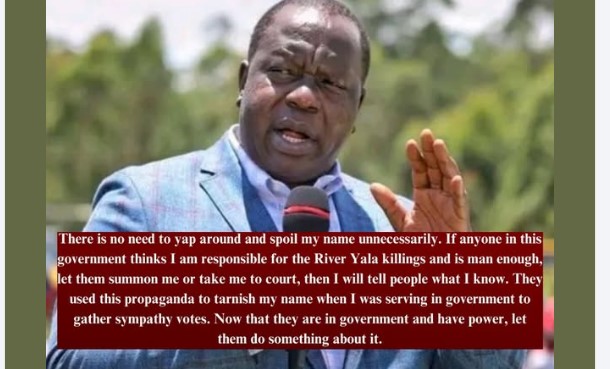
Former Interior Cabinet Secretary Dr. Fred Matiang’i has issued a bold challenge to the current administration, accusing government officials of tarnishing his name with unfounded allegations linking him to the infamous River Yala killings. In a fiery statement, Matiang’i said there is no need for government leaders to “yap around” and drag his name into political propaganda, daring them instead to summon him or take him to court if they believe he has anything to hide.
Matiang’i, who served as one of the most powerful figures in the previous government, expressed deep frustration with what he calls deliberate attempts to weaponize the River Yala tragedy to destroy his reputation. According to him, the accusations were originally crafted as a political tool to create sympathy for certain politicians during campaigns—suggesting that the narrative was never founded on truth, but on political desperation.
He insists that if the government truly believes he was responsible for extrajudicial killings, then they should act decisively. “If anyone in this government thinks I am responsible and is man enough, let them summon me or take me to court,” he said, adding that he is ready to “tell people what I know.” His statement implies that there are deeper truths behind the scenes—truths he appears prepared to reveal if pushed further.
Matiang’i’s remarks highlight the deepening political tensions between past and present power structures. As one of the most influential figures in the Uhuru Kenyatta administration, he has often been at the center of political controversies, particularly after leaving office. The River Yala killings—where unidentified bodies were reportedly dumped in the river—became a hot political topic and were frequently weaponized during the 2022 campaign season.
Supporters of Matiang’i argue that he is being unfairly targeted for political gain. They say that during his tenure, he strengthened national security, reformed policing, and maintained order, and that any attempt to link him to the killings is malicious and irresponsible. To them, his challenge to the government demonstrates his confidence and willingness to confront allegations head-on.
Critics, however, suggest that his remarks may be an attempt to shift blame or deflect scrutiny. They believe his tenure was marked by heavy-handed policing, and that questions surrounding extrajudicial killings remain unresolved. Some argue that if Matiang’i is indeed ready to speak, then a proper judicial or parliamentary process should be initiated to allow all facts to come to light.
Regardless of these differing perspectives, Matiang’i’s message is clear: he is tired of political insinuations, and he wants the matter addressed openly, formally, and legally. His daring statement has reignited debate about accountability, political propaganda, and the lingering controversies from Kenya’s previous administration.
As the government considers its next move, one thing remains certain: Matiang’i’s challenge has opened a new chapter in the ongoing political battles, and Kenyans will be watching closely to see whether the authorities will take him up on his demand—or continue engaging through public statements and political rhetoric.